Showing posts with label Lazarus. Show all posts

Saturday, April 4, 2015

Why does Jesus weep at Lazarus' tomb?

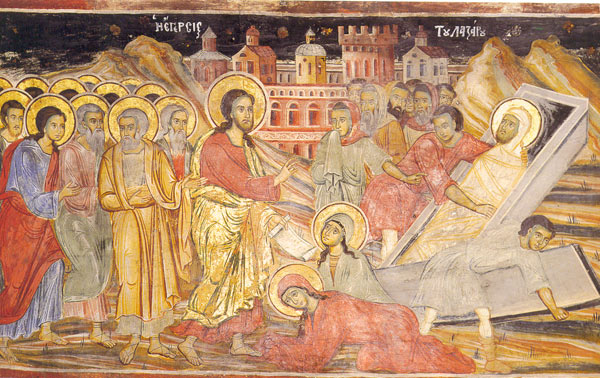
The Orthodox faithful have now reached the end of Lent and the beginning of Holy Week.  In a way, today and tomorrow are small, short-lived breaks or feasts, prior to the trial, agony, suffering, scourging, crucifixion, death, burial and triumph over Hades of Jesus before His Resurrection.  Today, we commemorate the rising of Lazarus from the dead, an event only recorded in the Gospel according to St. John, an event that occurred before His triumphal entry into Jerusalem where He would be humiliated and sentenced to a horrible death. 

The story is familiar to most people and its entirety is read today at Liturgy as the appointed Gospel reading.  It is some 45 verses long; a little longer than most Gospel readings.  However, as I was standing there, my thoughts concentrated only on one verse which has only two words:  Jesus wept (verse 35).  In context, it makes perfect sense.  In the verses prior, Mary was weeping as she chastised Jesus for not being present while Lazarus was still alive, although ill.  The company of Jews who had come to console her were also weeping.  There was a lot of weeping all around.

Why does Jesus weep?  There is no shortage of explanations, some of which can be found here.  The Canon written by St. Andrew of Crete which is appointed to be read at Compline the night before unambiguously attributes Jesus' weeping to His human nature which contrasts with His Divine Nature which allows Christ to raise Lazarus from the dead after four days.  Perhaps Jesus was weeping because it is perfectly acceptable to do so at a funeral as many of us know. Or perhaps Jesus wept simply because He knew that death was a tragic consequence of the sin that our parents, Adam and Eve, dared to commit in paradise.  If I dare to be presumptuous, maybe Jesus will weep over my tomb.

Though no theologian, I would posit a slightly different reason for Jesus' weeping though it is based on several of the explanations above.  As I wrote earlier, Jesus' raising of Lazarus occurs before His entry into Jerusalem and thus also right before His Trial, His Suffering, His Crucifixion, His Death and His Burial.  Before he was betrayed by Judas and lead by the guards to Pilate, Jesus prayed in the Garden of Gethsamene that His Father would let this cup pass from Him, that there could be a way out.  Of course, Christ goes on to pray, saying "Let Thine, not mine, be done."  Even on the Cross, Christ cries out in agony "My God, My God, why hast Thou forsaken me?"  There are no shortages of instances in the Gospel according to St. John where Jesus shows us that He is even afraid, scared to death, as it were.  I think that his weeping as he stands before Lazarus' tomb may indicate that He is frightened of the impending death and burial that is to await even Him in but a few short days.

Of course, this is only a guess.  St. John the Theologian doesn't explain why Jesus wept and maybe the question itself is, in the scheme of things, an unimportant one.  However, as we embark upon Holy Week and a walk with Christ in His suffering, crucifixion, death and burial, even though we know the joyous outcome of all of this, maybe we are called to weep before His tomb as He did at Lazarus' and even our own.

Saturday, April 12, 2014

Jesus Wept

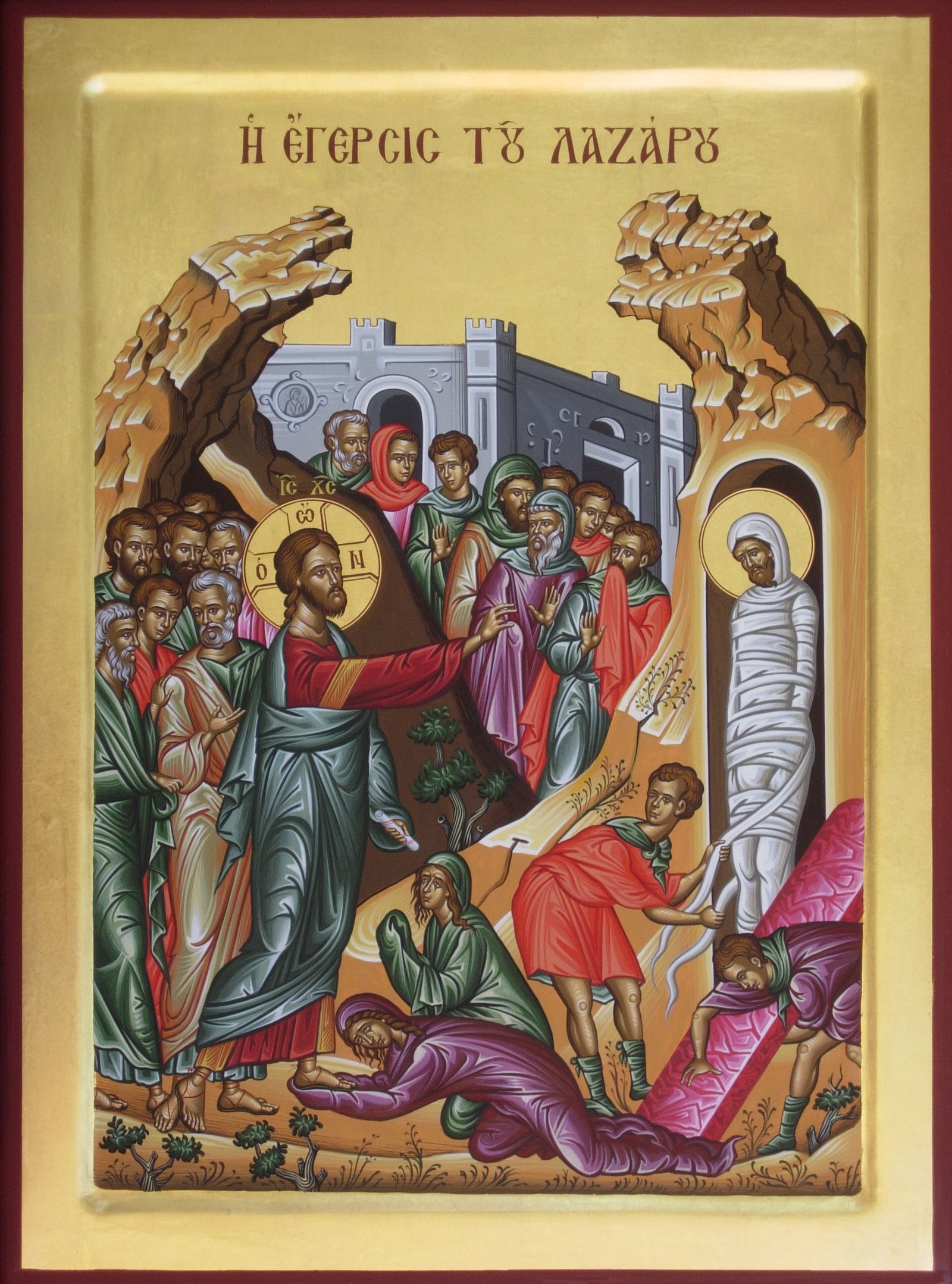
The Raising of Lazarus
The Holy Orthodox Church commemorates on the Saturday before Palm Sunday Lazarus who was four days dead.  It is an interesting and paradoxical service, not least because it is a miniature Resurrection service (at both Orthros and Liturgy) on a day normally reserved to commemorate the dead.  The Evlogetaria of the Resurrection is sung instead of the Evlogetaria of the reposed; the second antiphon and the eisodikon both refer to Christ rising from the dead, rather than being glorified in the saints, etc. 

The Gospel according to St. John is read at Divine Liturgy (there is no Orthros Gospel on this day) and the words that most poignantly stand out as if they were out of place and shouldn't even be mentioned are "Jesus wept."  The canons for this day used at Great Compline the evening before and at Orthros the day of, refer to Jesus' weeping as a sign that He truly became Man in contrast to His raising Lazrus which is a sign of His divinity.  Nonetheless, the words "Jesus wept" get our attention more than even Christ commanding Lazarus to come out.  Why?  Fr. Alexander Schmemann writes about this:

At the grave of Lazarus Jesus encounters Death — the power of sin and destruction, of hatred and despair. He meets the enemy of God. And we who follow Him are now introduced into the very heart of this hour of Jesus, the hour, which He so often mentioned. The forthcoming darkness of the Cross, its necessity, its universal meaning, all this is given in the shortest verse of the Gospel — "and Jesus wept."
We understand now that it is because He wept, i.e., loved His friend Lazarus and had pity on him, that He had the power of restoring life to him. The power of Resurrection is not a Divine "power in itself’," but the power of love, or rather, love as power. God is Love, and it is love that creates life; it is love that weeps at the grave and it is, therefore, love that restores life... This is the meaning of these Divine tears. They are tears of love and, therefore, in them is the power of life. Love, which is the foundation of life and its source, is at work again recreating, redeeming, restoring the darkened life of man: "Lazarus, come forth!" And this is why Lazarus Saturday is the real beginning of both: the Cross, as the supreme sacrifice of love, and the Common Resurrection, as the ultimate triumph of love.--The Christian Way, 1961
Lent is now ever.  Our repentance must continue, but we focus less on our own efforts and concentrate fully on what Christ has done for us in this week of salvation.  Today is but a taste of the glory to come at the Passion and Resurrection next week.   Happy feast!

Friday, June 4, 2010

Commemoration of Sts. Martha and Mary, sisters of the Righteous Lazarus


Today (new calendar), June 4, the Holy Orthodox Church commemorates Sts. Martha and Mary, sisters to St. Lazarus, whom Christ had raised from the dead after he was four days dead. Following Christ's crucifixion, Martha and Mary joined the other myrrh-bearing women (who are commemorated on the second Sunday following Pascha) to anoint Christ's body with oil and spices. They were the first witnesses to Christ's Resurrection and Triumph over death. Following His Ascension, the sisters with their brother departed from Galilee and preached the Gospel together in Cyprus, where Lazarus was also later made bishop. All three reposed there, according to local Cyprus tradition.

One may also remember the story of Martha and Mary from the Gospel according to St. Luke. Jesus visits the home of the sisters and as Martha is going about the house to fulfill her duties to their guest, Jesus, Mary is sitting at Jesus' feet, hanging on to His every word. When Martha complains to Jesus saying that Mary should be helping her in the kitchen and in the house. Jesus responds that "Mary has chosen the better part for herself." Together, the sisters represent the two necessary bedrocks of Christian spirituality, contemplation (Mary) and action (Martha).

On another note, the day before Palm Sunday is Lazarus Saturday which replays the drama of Christ resurrecting Lazarus shortly before His own crucifixion and resurrection from the dead. In the Arab Orthodox churches there is a hymn, often used as a koinonikon (i.e. communion hymn) and also used on Palm Sunday during the Procession called, "Rejoice, O Bethany." It is a dialogue between the sisters of Lazarus, Martha and Mary, and the Lord and one of the hymns that I, as a chanter, look forward to chanting every year as we approach Holy Week and Pascha. Below you can hear an English version of this hymn based on the Hijaz-Kar scale of Byzantine modal system as chanted by the Boston Byzantine Choir.