Showing posts with label Triodion. Show all posts

Sunday, February 21, 2016

The beginning of the Triodion

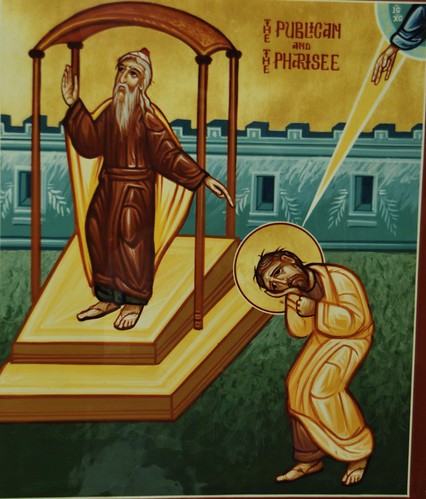
Icon of the Publican and Pharisee. He who humbles himself
will be exalted.  He who exalts himself will be humbled.
For the next ten weeks to varying degrees, the Orthodox Church will use principally the service book of the Triodion, a collection of hymns for the services throughout the pre-Lenten, Lenten and Holy Week periods.  It is a magnificent collection of great hymns, the vast majority of which few Orthodox Christians will actually use and pray unless they are monastics.  That is a great loss.  I believe that every Orthdox Christian should own a copy of the Triodion and make use of it in his devotional life as much as he can.

Today is the first Sunday of the Triodion where we take special notice of the Parable of the Publican and the Pharisee.  The lessons contained in those four verses from St. Luke's Gospel are numerous, but the one thing that we should focus on is whether we, in our spiritual lives, are more like the publican or the pharisee?

Most of us, if we were honest, would answer that we are more like the pharisee.  Even more of us would answer that this parable, like so many other parables of the Lord and exhortations of the prophets, concern everyone BESIDES us.  Those were written down for other people, not for someone like me who is just trying to get through  life, make a living, love my wife and kids and not get into trouble.  But, even that train of thought puts one well into the pharisee camp.  Such an evaluation of life being rooted in just doing the right things is exactly where the pharisee stands when he is in the temple.  He does do all the right things and wants to be congratulated for it.

Most of us, if we were honest, would admit we do not enter the Temple of the Lord with downcast face and with a cry of mercy to forgive us our sin, whatever that may be, however little it may be.

Most of us, if we were honest, would admit that being pharisaical isn't really bad at all.

Most of us, if we were honest, would admit that humbling ourselves runs counter to our culture of self-satisfaction, self-validation, self-importance, ego-driven world we find ourselves and maybe seek to change that.

Most of us, if we were honest, would prefer material gifts over spiritual ones.

Most of us, simply, do not want to be the publican.

But that is the spiritual life.  Does God accept us as we are?  Sure.  But he also says that if we love Him to keep his commandments.  That requires humility which almost every single Church Father and Desert Father says is the beginning to becoming like God.  But we want God to do the work for us and yet we still demand credit. God does the work, but so must we.  God did not create a race of automatons to function only according to a certain program.  He created a race in His image and likeness to grow into mature human beings in communion with him.  But that can only happen if we first humble ourselves to the point that we are not equal with God and that we have sinned against our Creator.  That's not a bad thing.  Humility takes  a lot more courage and effort than exalting ourselves for managing to dress ourselves every morning.

The Lenten period is about fasting, prayer and repentance. In short, it's about work.  The work to drag ourselves out of the pit of our sins.  Yes, Christ did do that on the Cross and then in  Hades, made glorious in His Resurrection.  But He did that so that we could also work out our on salvation with fear and trembling.  St. Paul may as well have said humility.

So, let us embrace humility now for the Lenten season that will be upon us in a few very short weeks.  Happy Triodion, everyone!

Monday, February 20, 2012

The Third Sunday of Triodion: The Last Judgment and Meatfare


The text: Matthew 25: 31-46
The lesson: love, Christian love

It is difficult, at face value, to read any of the parables or Christ's warnings of the end times and come away from them with the same hope and joy that one would hear from John 3. But, love is at the very heart of the parable which forms the Gospel for the Third Sunday of Triodion. After this Sunday, no more animal flesh is to be consumed (for those who follow the fast strictly) until Pascha morning. So how is that a parable talking about our Lord's return and the fear that should ensue from it also be a parable of Christian love? The key is in the second half of the parable. Fr. Alexander Schmemann explains it best:

The parable of the Last Judgement is about Christian love. Not all of us are called to work for "humanity," yet each one of us have received the gift and grace of Christ's love. We know that all men ultimately need this personal love--the recognition in them of their unique soul in which the beauty of the whole creation is reflected in a unique way. We also know that men are in prison and are sick and thirsty and hungry, because that personal love has been denied them. And, finally, we know that however narrow and limited the framework of our personal existence, each one of us has been made responsible for a tiny part of the Kingdom of God, made responsible by that very gift of Christ's love. Thus, on whether or not we have accepted this responsibility, on whether we have loved or refused to love, shall be judged. For "inasmuch as you have done it unto one of the least of these My brethren, you have done it unto Me..."--Great Lent, p. 26


If I can be so bold to add to Fr. Alexander's words, I would also say that the fear that one may take away from the first part of this parable is in no way incompatible with the love present in the second part. As we come forward to receive our Lord's Holy Body and Blood in the Mysteries, the priest says, "With fear and love, come forth." According to Proverbs, fear is the beginning of wisdom. And if we are wise, we are also loving. Fear and love are two sides of the same coin. They are not opposites, but complement each other. I would suggest that we fear not so much because punishment may ensue for stepping out of line, but we fear because love is made perfect by it. Our Lord feared that His creation may perish so in His love for man, He gave His Son to save it. That's how I see it anyway. I'll leave it at that.

Saturday, February 18, 2012

Some (more) notes on fasting

As Christians approach the Great Lenten season, they will hear a lot about fasting. The exhortations are myriad: Don't fast, fast only if you can, fasting is trying to win points with God, fast only on certain days, eat this but not this, etc. Even among Orthodox jurisdictions, there are different practices which are driven by circumstances of history and geography. For instance, in the Greek churches, fish is allowed on Annunciation (March 25) and Palm Sunday. However, because the climate was much colder and the availability of vegetables and grains more scarce, the Russian churches said fish was permissible all through Lent, though only on Tuesdays, Thursdays and weekends.

For those of us Orthodox who have friends and family in heterodox communions, it's easy for us to condemn their adversity towards fasting. We should let them continue as they will. At the same time, we are often the victims of attacks from leaders of these heterodox communions (especially if we left) who say that fasting is nothing but legalism, something that you have to do. Let's make it very clear: Fasting should be something we WANT to do. If you don't want to, don't do it because fasting is not the end, it is a means to an end.

The big problem, especially in mainline Protestantism, is a schism between the soul, the mind, and the body. The body has been exorcised from modern worship, while everything is focused on the soul and mind. Sometimes I wonder if Manichaeism and Gnosticism have really been eradicated from the church. In most Protestant buildings, there are no images, there is no communion, there is no incense. The presence of these is to elevate all the five senses. Essentially, the body is left out of prayer when it should be involved just as much. The Lord says that He should be worshiped with all our soul, mind and body, but why is the body ignored? The discipline of fasting is, to borrow from a recent book on the subject, to bring the body into the act of repentance. Though the Greek work for repentance, metanoia, means change of mind, our mind and body are united. The body is guided by the mind. We don't just train one and ignore the other. Both are involved.

Speaking of both mind and body, if the body is being disciplined so must the mind. The body is starving from certain foods which nourish it for most of the year and it groans. To prevent us from being guided by our stomachs, we must employ more and more prayer. Less food=more prayer. Even our Lord said as much.

Fasting, as fine a discipline as it is, should never be done with a possibility of harming oneself. And it should never be looked at as a means to win points with God. Bishop KALLISTOS writes:

At all times, it is important to bear in mind that 'you are not under hte law but under grace' (Rom. 6:14), and that the 'letter kills, but the spirit gives life' (2 Cor. 3:6). The rules of fasting, while they need to be taken seriously, are not to be interpreted with dour and pedantic legalism; 'for the Kingdom of God is not food and drink, but righteousness and peace and joy in the Holy Spirit' (Rom. 14:17).--"The Meaning of Great Lent" from The Lenten Triodion, p. 37


And it is important also to remember to be joyful as we do this. To fast and be despondent is not the way of the Christian life.

Sunday, February 5, 2012

The First Sunday of Triodion: The Publican and the Pharisee


Gospel: St. Luke 18: 10-14. The lessons: humility and repentance.

The Lenten season begins then by a quest,a prayer for humility which is the beginning of true repentance. For repentance, above everything else, is a return o the genuine order of things, the restoration of the right vision. It is, therefore, rooted in humility, and humility--the divine and beautiful humility--is its fruit and end.--Fr. Alexander Schmemann, Great Lent, p.25

The fault of the Pharisee is that he has no desire to change his outlook; he is complacent, self-satisfied, and so he allows no place for God to act within him. The Publican, on the other hand, truly longs for a "change of mind": he is self-dissatisfied, "poor in spirit," and where there is this saving self-dissatisfaction, there is room for God to act. Unless we learn the secret of the Publican's inward poverty, we hall not share in the Lenten springtime.--Bishop KALLISTOS, "The Meaning of the Great Fast" from The Lenten Triodion, p. 40

The Church welcomes the Lenten spring with a spirit of exultation. She greets the time of repentance with the expectancy and enthusiasm of a child entering into a new and exciting experience. The tone of the church services is one of brightness and light. The words are a clarion call to a spiritual contest, the invitation to a spiritual adventure, the summons to a spiritual feat. There is nothing gloomy here, nothing dark or remorseful, masochistic or morbid, anxious or hysterical, pietistic or sentimental.--Fr. Thomas Hopko, The Lenten Spring, p. 9

Brethren, let us not pray as the Pharisee: for he who exults himself s hall be humbled. Let us humble ourselves before God and with fasting cry aloud as the Publican: God be merciful to us sinners.

A Pharisee, overcome with vainglory, and a Publican, bowed down in repentance came to Thee the only Master. The one boasted and was deprived of blessings, while the other kept silent and was accounted worthy of gifts. Confirm me, O Christ our God, in these his cries of sorrow, for Thou lovest mankind.--Idiomela stichera at Psalm 140 at Great Vespers

Friday, February 3, 2012

One long journey done...another one to shortly begin

On November 15, we started fasting and praying fervently in anticipation of our Lord's Incarnation, taking on humanity in all ways. On December 23, we celebrated the Royal Hours which proclaimed the truth of the Old Testament Prophets. On December 24 and 25, we celebrated the actual feast of our Lord's coming in the flesh with the Magi who were there to adore Him. Our fasting changed to feasting uninterrupted for 12 more days.

On January 1, we celebrated our Lord's Circumcision in the Flesh, by which He showed Himself to be not a destroyer of the law but its fulfillment. With another short fast on January 5, we celebrated Theophany, our Lord's baptism in the Jordan at the hands of John the Foreunner, where creation and creator were united and the Trinity was made manifest. We gave especial attention to His Baptizer, John on January 7, the one who prepared the way for the Lord. We continued to celebrate Theophany for 8 more days.

During the rest of January we celebrated the memories of many great saints who proclaimed the mystery of the Incarnation and the dogma of the Trinity in Unity. Father such as as Sts. Basil the Great and Gregory the Theologian vigorously defended the doctrine of the Trinity against the Arians. Sts. Cyril and Athanasius defended vigorously that our Lord was not two persons but one united in Christ and whom Mary did give birth to was indeed God and thus she was Theotokos. St. Maxiumus the Confessor refuted the evils of the Monothelete heresy, which was an offshoot of monophysitism and Arianism. All these heresies denied that Christ is BOTH truly God and truly human.

We also commemorated great ascetics such as St. Anthony the Great who lived the Christ-like life, renouncing the trappings of this world, emptying themselves of them as Christ emptied Himself of His Divinity, to commune more with God.

We celebrated great hymn writers and commentators on the Christ-like life and the Scriptures, notably St. John Chrysostom, St. John of Damascus and Sts. Ephraim and Isaac the Syrians. Their words continue to form the prayers for the repentant.

We commemorated great martyrs such as Sts. Barbara, Eugenia, Anastasia of Rome and others all of whom gave their life for the Bridegroom whom they loved because He loved us.

We celebrated again the Feast of the Meeting of our Lord where our Lord, again in fulfillment of the Law, was brought by his parents to the Temple in Jerusalem, where He was seen by the Righteous Simeon and Anna who both proclaimed that this child was the salvation which God had promised to the nation of Israel.

For more than 80 days, a little more than 1/5 of the total year, our devotion was centered on our Lord's incarnation. Tomorrow, Orthodox Christians begin yet another journey, the journey to the empty tomb of Christ and the Lord's sending of the Holy Spirit to proclaim what the Lord has done. This journey will be much more difficult as the events that we commemorate during the Great Lenten fast up through Holy Week, really do not mince what we are, what we have become because of our sin and our absolute need of God. Our fasting will be intense, our prayer even more fervent, the remembrance of the Patriarchs and Old Testament fathers who only had small foretastes of what would be realized in Christ will be at the center of our meditations.

Tomorrow, with the beginning of Triodion, we are called to repentance which can only be realized by the addition of what the publican had and the pharisee lacked: Humility. If we lack that single virtue, the next 120 days (the total time of the Triodio and the Pentecostarion), the next 1/3 of the year will be a difficult journey. Even if we should stumble, multiple times, five or ten times a day, there is always one more chance to get up.

Our Winter Pascha must give way to the Lenten Spring. Our feasting must give way to fasting. Our joy will now turn to sadness. But it will be a bright sadness for we already know the outcome: the Resurrection!

Saturday, January 14, 2012

WARNING! Triodion starts in 3 weeks


I was looking ahead on the calendar for the next few Sundays and to my surprise and also to my satisfaction, we start Triodion on February 5!

We have just taken leave of Theophany. The Christmas gifts are still being appreciated and though there is no snow right now, the weather has been getting colder again to make it seem like winter! Now, in three weeks time we will begin the preparation for Lent which prepares us for Pascha.

That's what I love about the Church calendar. It keeps you on your toes and does not allow you to be complacent about repentance for too long!

I guess I had better start preparing "Do thou open for me the Gates of Repentance" for Orthros!

Sunday, February 20, 2011

The Second Sunday of Triodion--Lesson #2: Exile and Repentance


Of what great blessings in my wretchedness have I deprived myself! From what kingdom in my misery have I fallen! I have wasted the riches that were given to me, I have transgressed the commandment. Alas, unhappy soul! Thou art henceforth condemned to the eternal fire. Therefore, before the end cry out to Christ our God: Receive me as the Prodigal Son, O God, and have mercy upon me. Doxasticon at Psalm 140 at Vespers for the Sunday of the Prodigal Son


Perhaps my favorite parable in the New Testament, the parable of the Prodigal Son makes us to recall why we need Great Lent prior to Pascha. We need Great Lent because we are exiled from God, just as the prodigal exiled himself from his home and became a slave in a foreign land. The prodigal's sin physically exiled him from his father. Our sin exiles us from communion with God, which is why we don't walk with Him in Paradise. This is not some metaphysical metaphor or allegory. This exile is ACTUAL, PHYSICAL and SPIRITUAL! If it weren't then why would we need the Eucharist at all Liturgies or confession or baptism? We wouldn't. Our bodies are physically removed such is why the sacraments are a part of our Christian lives.

The second lesson is repentance, which is the lesson for all of Lent. That very word began John the Baptist's and Christ's ministries. For those who decry Lent and see it as a bunch of legalisms that are incompatible with a modern, enlightened understanding of Christianity, repentance is unnecessary since their Christianity has been replaced by feelings. "To repent is not to feel dissatisfied, but to make a decision and to act upon it." (Lenten Triodion, 44), just as the prodigal says that he will rise and go (verse 18). Repentance is not just about feeling bad, it is admitting that we are alienated from God and that we need to do something about it. Christ has done the work so that we may follow Him; Christianity is not passive which brings us to another reason as to why we need Great Lent.

If repentance is the lesson of this Sunday and the whole of Lent, then Lent is the school to continually teach it, as Fr. Alexander Schmemann says. In school, we are taught and then must apply the teachings. Of course, there are way too many who think that merely showing up to the lesson qualifies for a passing grade. It does not.

So what is repentance? It is literally "a change of mind." The word in Greek is metanoia. The elements are "meta" which talks of change, hence in other words like metamorphosis and metathesis and "noia" from "nous" which is, according to St. John Damascene, the eye of the soul. Repentance is to change us, physically and spiritually. It is no mere lip service, it is not showing up for one or two extra services, it is not saying one more "Our Father" and it is not "going to confession once a year." Lent and repentance are not for us to get things legally in order prior to the next Lenten season. It requires and demands a change! Yes, going to more services, praying more and confessing are all great things to do, but unless they comprise your Christian habit, you will not be any different in substance!

As we come closer to the beginning of Great Lent, let us embark with the knowledge that we are exiled from God and that only by a change of mind, a change of our very selves can we enter into the Kingdom of God, our country and be received once more as God's child.

Sunday, February 13, 2011

Hymn at Sunday Orthros during Triodion

These troparia accompany us all through the Triodion and Great Lenten fast. Following the reading of the Gospel of the Sunday Eothinon (these are the 11 Resurrection appearances of Christ in the four Gospels) and the reading of Psalm 50, we chant in the plagal of the fourth tone:

Glory...Open unto me the gates of repentance, O Giver of Life,
For my spirit rises early to pray towards Thy Temple
Bearing the temple of my body all defiled;
But, in Thy Compassion, purify me by the loving kindness of Thy mercy.

Both now...Lead me on the paths of righteousness, O Mother of God,
For I have profaned my soul with shameful sins
and have wasted my life in slothfulness.
But, by thine intercessions, deliver me from all impurity.

Have mercy...When I think of the many evil things I have done, wretch that I am,
I tremble at the fearful day of judgment.
But trusting in Thy loving compassion, like David I cry unto Thee:
Have mercy upon me, O God, according to Thy Great Mercy.

Saturday, February 12, 2011

Triodion Begins--Lesson # 1: Humility


Today was the beginning of the use of the Lenten Triodion. The next four Sundays in the Eastern Rite churches are pre-Lenten but serve as springboards for how we are to enter into the great fast with attention to our spiritual plight, the necessity of our Lord's cross and repentance. Today is the Sunday of the Publican and the Pharisee.

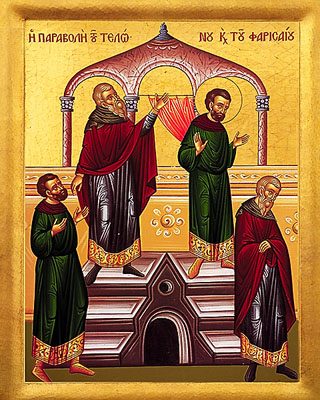
I need not go into a full recap of the story since this is probably one of the most familiar parables from the Gospel according to St. Luke. Two very different men, a tax collector loathed by all and a Pharisee, a member of the "holier than thou" religious party both enter into the synagogue to pray. The Pharisee boasts of his own great deeds; the publican can only boast of his sinfulness. The Pharisee exults in his generosity; the publican exults in his meekness. The Pharisee praises his alms-giving; publicans were well known for outright theft. The Pharisee commends his own phsyical fasting from foods; the publican does not fast from his sins. The lesson of this parable can be summed up in one word: HUMILITY.

Our society has a skewed idea as to what is considered humility. Some view humility as the inability to take a complement. "Hey, you're a good singer." "No, I'm not." "Wow, that guy is so humble." Others view humility as not reacting in the same manner when another person attacks or curses you. In most cases, we harbor resentment towards the person that attacks and curses us. Humility is not a passive aggressive trait.

Humility derives from the Latin word, humus which means "earth." To be humble and to possess humility one must be as the earth. Consider what we humans do to the earth. We pollute it, we contaminate it, we treat it as a commodity. But, in spite of all of that, the earth produces wheat, fruit and other great plants in abundance for us. And it keeps doing so year after year, of course helped by man's innovations. To be humble is to not simply shrug off complements or foster a passive aggressive mindset to those who persecute us. Humility and being humble is to be steadfast in the Gospel to bless those who curse, pray for those who persecute, love those who are indifferent or even spiteful. It is to regard ourselves as the lowest so that others may have what is the highest.

To live the Life in Christ, humility must be paramount. Without humility all other virtues we have will be for naught. Such is why that this week is free from all fasting on Wednesdays and Fridays. Fasting, as excellent and necessary it is as a spiritual discipline, is only a diet without humility. Fasting without prayer, without alms giving, without our eyes on Christ is nothing more than a change in diet. Humility must be incorporated.

How do we practice humility? For starters, we must do as the publican does. In our churches, in our icon corners or at any time we pray to God, we must first confess that we are sinners and that only God can forgive our sins. Yes, give thanks to God and entreat Him for what you need, but be mindful of your own sinfulness before the Lord who made you not to be a sinner but to be in His image and likeness.

Let us begin our journey to Golgotha with humility!

Wednesday, January 27, 2010

Triodion begins--The Sunday of the Publican and Pharisee

We have just put away the decorations for Nativity, blessed the waters and our homes celebrating the joy of our Lord's Theophany and now, before January is over, we have begun Triodion. I can't help but think how much though my fellow Orthodox miss at Vespers and Orthros for this day. Sure, they hear the gospel at the Liturgy which directly pertains to this feast, but the supporting hymnography, really hits home what this day means for us in the spiritual life.

The Gospel lesson for this day is short, incredibly short. In fact so many Gospel pericopes appointed for certain days are extremely short. Circumcision is only one verse; Transfiguration only two or four (depending on which account you read); Theophany is not much longer. Our Lord's words in his parables are meant to bring us straight to the point, not to be beaten up with fancy word analysis and redacted so that we can better understand the metaphors. The point of this Gospel: Humility!

Our Lord asks, "Who went home justified?" The answer is, of course, the Publican. Why? Because he humbled himself before God. And why is that such a great virtue to have? Because God has that virtue. We often don't think of God being humble, preferring such superlatives as greatest, most holy, most awesome, most compassionate, most loving, etc., etc.. But God is above all humble and that is why he is compassionate and loving. To be humble is to be humiliated. And God was humiliated (not always a negative term) because of his Incarnation in the flesh when He took on what we are and humiliated Himself unto death, even death on a cross, as St. Paul tell us. God's loving and merciful compassion is poured out for us because He, even before we sinned, as some Church Fathers say (cf. St. Athanasius), God was to come in the flesh and die, to raise us up so that we may take on the divine while we yet live here on earth. To be humble is thus to be Godlike.

I should say a few words about the Pharisee and his prayers. There is absolutely nothing wrong with what the Pharisee says he does. There is nothing wrong with fasting and giving to the poor. In fact, as the fasting season approaches, we are reminded to do both and join more prayer with those virtues. Many people read this Gospel passage (incorrectly) and suggest that Christ is condemning works and that only our faith matters (sola fide). Such cheapens the Gospel. If our faith is a mental activity only, then we are not wholly transformed. If the flesh will not do as the body, then we have become schizophrenic beings instead of a union of mind, body and soul. Does our Lord not command us to love Him with all our mind, body and heart? If we only love with the mind, yet not the body, we do not love God and we cannot love God. God did not come in the flesh because He thought the flesh was bad or only to nourish the spirit. Such a thought is dangerous. It is modern day Manichaeism and gnosticism. God came in the flesh, assuming everything we are so that all things may be healed so that we can glorify our God in works (cf. Eph 2: 9-10). The Pharisee's problem is not with what he does but how his good works are motivated not for love of God, but for love of himself. Good works (on the surface) can come from bad people, but if they are not directed towards a love for God, then they are suspect by God.

The theme of this past Sunday is humility. Next week, the Sunday of the Prodigal Sun, the theme is return from exile. More then.

Friday, January 22, 2010

We waited...

Bishop NIKOLAI Velimirovich of Ohrid once said as he was present at Pascha in Jeruslaem, "We waited, and at last our expectations were fulfilled. When the Patriarch sang 'Christ is Risen', a heavy burden fell from our souls. We felt as if we also had been raised from the dead. All at once, from all around, the same cry resounded like the noise o fmany waters. 'Christ is Risen' sang the Greeks, the Russians, the Arabs, the Serbs, the Copts, the Armenians, the Ethiopians--one after another, each in his own tongue, in his own melody...Coming out of from the service at dawn, we began to regard everything in the light of the glory of Christ's Resurrection, and all appeared better, more expressive, more glorious. Only in the light of the Resurrection does life receive meaning."

Though NIKOLAI's narrative goes into great length about the joy and the benefits of Pascha, the first two words of his description deserve special attention: We waited. In this context, I am sure he is speaking more than just of waiting for the service to begin. I am quite sure that he is speaking of the waiting undergone during Great Lent and Holy Week for our Lord's Pascha.

Today begins Triodion. I can hardly believe that after the joy of Nativity and Theophany, we are so soon about to plunge ourselves into the holy season of repentance where we wait for our Lord's Pascha! In these four Sundays before the beginning of Great Lent, we recall the humility of the Publican, the repentance of the Prodigal as well as the rejoicing of the Father for such repentance, the Last Judgment of our Sins and the expulsion of Adam and Eve from Paradise. In all that, we wait...for Great Lent. Then Great Lent is upon us where we fast and pray and give alms, still waiting...for Pascha.

We wait, which means we prepare. And we have to prepare. Bishop NIKOLAI saw this clearly. Without the waiting, without the preparation there can be no rejoicing, there can be no sense that as the dead are raised, so we are raised from our sin. Without that preparation, our hearts are as empty as the empty tomb. And the empty tomb becomes an anecdote of history rather than the key to our salvation.

We cannot simply come into the presence of God. For those who only want 30 minute church services with happy clappy music and short prayers and no mention of sin, you are not asking for the presence of God. You are asking for the presence of the flesh to mask the presence of God. Though it is an insult to search out God since God is everywhere, it is insulting to suggest that one can simply come into the presence of God, whether by just entering a church or saying one short prayer or singing a hymn. Coming into the presence of God takes time and effort...a lot of them, too! Because we are so hardened in sin, we cannot see that God still does walk among us and even if we could see such a thing happening, many of us would not want it. You cannot simply come into the presence of God. You must prepare.

Infants must crawl before they can walk. Why do we lowly sinners demand that God reveal his majesty to us immediately before we can even look upon the light of the sun? It's probably sheer laziness. Preparation takes time and no one wants to rid themselves of their precious time which could be directed towards TV, family, business, work, sports, etc.

Even if it is impossible to prepare all the time, it is very possible to prepare some of the time, to make more effort than one would during the rest of the year.

Let us prepare. Let us purge ourselves of our sins. Let us desire God if only because He has desired us.

Blessed preparation to all of you!