Showing posts with label Liturgy. Show all posts

Sunday, December 14, 2014

Uniform for Church?

I teach at a private school where the students are required to wear uniforms.  On Monday and Wednesday through Friday, young men may wear khaki pants (or shorts, weather providing) and a green polo shirt or anything else as long as it has the name of the school.  Young women may wear khakis, but are more encouraged to wear plaid skirts with a polo shirt or anything else with the name of the school. On Tuesdays, all students wear their formal uniforms which, for guys, are gray pants, button down white shirt and tie with a navy blazer.  Ladies are required to wear skirts, a white shirt with a navy blazer, and knee high socks.   Most of our school population observe these rules consistently. 

However, on certain days of the year, there are out-of-uniform days.  This may extend to only the kids in one particular grade as a reward or to the entire school prior to the winter holiday during their final exams or during homecoming week.  Every time there is an out-of-uniform day, there is an obvious decline in learning and in discipline in general.

My wife teaches at a public school; I did so as well.  We have both pondered the effects if a uniform policy were instituted at a public school like at the one she teaches.  I suggest that the benefits far outweigh the drawbacks.  The two in particular "pros" are 1) teachers would not have to be forced into awkward positions to reprimand students for not dressing according to the established guidelines (I can attest that as a guy teacher trying to tell a young lady that the spaghetti strap strings are inappropriate or that her shirt is cut too low that too much of her cleavage is exposed or that her shorts are too short, such is really awkward and some women will even go so far as to suggest that you're some sort of pervert for even noticing) and 2) students will not be able to "bully" anyone who doesn't wear the "right" clothes.  Will that also lead to increased student learning?  I don't know, but I think that it should be tried before it is written off as ineffective.

Let's apply this standard to church and what we should wear.  Does God care?  I would like to think that our coming to church and worshiping and praying are more important to him than our choice of attire, but we have to remember that what goes on at church is a communal activity.  Throughout St. Paul's epistles, he exhorts his readers to not be stumbling blocks (Greek skandalon) to others  by keeping the  fasts or not, for example.  Should a uniform policy be adopted by any church as a way to prevent others from stumbling during church?

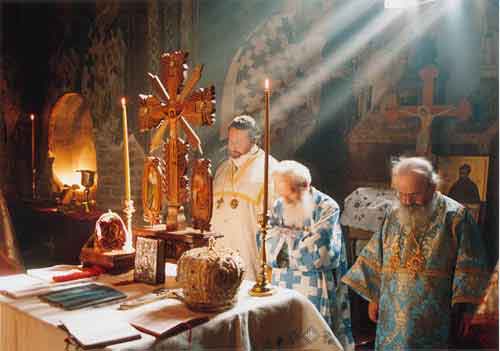
In a sense the church already has such a policy.  Priests are vested particularly to reflect their office before God as are deacons as are the taper bearers as are the chanters and readers.  Why for them and not for the laity?  The uniforms are signs of the work that the persons wearing them are doing.  What is the job of the laity?  Like everyone else, it is to pray.  Should they not be marked out in a way to indicate that?   I know that an Orthodox Christian would balk if he saw his priest during the Divine Liturgy in anything besides his vestments. 


There are many arguments which I will not rehash here as to why more formal attire should  not necessarily be expected of parishioners.  I would just say that if we take such care to choose our clothing for concerts, parties, receptions, business meetings, lounging around the house, working in the yard, etc., why would we not put the same thought into what we wear in the House of the Lord?  Would more praying be accomplished if all men wore at least khakis and a polo shirt and women wore dresses?  Would there be more reverence and less talking from the parishioners if men wore suits and women wore nice hats?  I don't believe there is any way to measure this.  Anything that may change may well have to be measured against the fallacy of post hoc ergo propter hoc.

As Orthodox Christians we are taught that everything in the Church is more than a mental activity. Our prayer life is more than a mental activity.  That's why we kiss icons, we cense the Church, we taste of the Body and Blood of Christ, we bow, we prostrate, we make the sign of the Cross.  Our Church's praxis is not one of Gnostic dualism, but where the body and soul come together in worship of God.  Shouldn't that also include the manner of our dress that is humble, not gaudy, and shows respect rather than receive attention?  And if we chose our clothes in such a manner would that not also translate to how we approach God in prayer while in His holy place?

I only have questions, no answers.  I seriously doubt my parish or any other parish for that matter would willingly let me do a study on that, as they should.  But if we emphasize comfort too much, how long before people start showing up in sweatpants or bathrobes with slippers on?


Wednesday, June 4, 2014

Another Front in the Worship Wars Opens

For those of us who grew up in a "mainstream" Protestant Christian denomination, there was considerable tension between those of us who favored the "traditional" liturgy vs. those who favored more "contemporary" style of worship with a "come-as-you-are" feel.  We call these the worship wars and every Protestant denomination and even the Roman Catholics have fought in many battles.  Both sides have been bloodied and bruised, but the banners of each still go forward. 

Traditionalists have balked at hearing of services dubbed "U2charist" or "Polka liturgy" or a "Beatles Liturgy" or any service using the music of today's or a few yesterday's popular music.  Traditionalists facepalm all the more when they hear of "Clown Masses."  Take your pick.  Rock n' roll, once public enemy #1 of the churches, has now been co-opted by churches for its own repackaging and branding.  What more could happen?

Well, apparently the community of beat boxers, R&B soloists, and thuggish rappers thought they were getting the short end of the stick by the churches so now a North Carolina church is giving in to (wait for it):  Hip-Hop liturgy.  I suppose it was only a matter of time. 

The same arguments which are used to justify any contemporary music in worship from the Beatles to U2 are also used to justify the existence of a Hip-Hop liturgy:  appeal to younger people, appeal to the non-churched, appeal to what people want, etc., etc.  I'm not going to refute these arguments, though I can and easily.  But here is what will inevitably happen:  There will be no growth.  Oh sure, you'll get a little spike at first, but it's going to be short lived and ephemeral.  If you strictly appeal to what people like and then try to give them an emotional attachment, a "musical high" if you will, what will happen when that "high" wears off?  People will leave to find their wants and desires elsewhere. A church which operates this way may get new visitors every week, but how many of them will actually stay and become involved with the community?  Not very many, I reckon. 

Churches which operate on the mechanism on giving people what the people want are essentially functioning as drug dealers.  They give out something which immediately gratifies, but just like the drug user who realizes that more and more of the drug is needed to achieve the same high, the itinerant church-goer whose primary concern is what satisfies him will go to another church that can achieve the same thing with little or no effort on his part. 

This is not a solution for the problems churches face with today's youth who are not as religiously devout as their parents.  It's only a band aid for a leaky dam.  If a church offers the same as the world, why does it expect a mass exodus from the world to inside its doors? Why would someone in love with the world want to do the same thing but in a location which maybe has some pews, some religious art and a pastor?  Why?

The Church is eternal and Christ says that the Gates of Hell will never prevail against Her.  So why do so many churches continue to try and evangelize using only the most ephemeral of methods?

Monday, September 20, 2010

Want Chalcedonian Theology? Better come to more than just the Liturgy!

This past weekend, we were very fortunate to have a visit from Fr. Patrick Reardon, pastor of All Saints Orthodox Church in Chicago. Fr. Patrick is the author of many books (none of which I admit I have read, but will get to eventually) including, Christ in the Psalms, Christ in the Saints, Chronicles of History and Worship, etc.. His talk was on the saints and what that means especially in an age of apostasy in which we now live.

The Q&A session was all over the place with questions ranging from hymnography to dogmatic theology to systematics to hagiography to icons to Scriptural exegesis. In short, there was something for everyone.

I cannot remember exactly how this came up, but Fr. Patrick revealed something that I have never fathomed before: The main liturgies of the Orthodox Church (i.e. the Liturgies of St. John Chrysostom and St. Basil the Great) are pre-Chalcedonian. This, of course, refers to the Fourth Ecumenical Council which convened at Chalcedon in 451 to discuss and clarify the doctrine of Christs' Hypostatic Union which was an extension of clarifying Mary as Theotokos at the Third Ecumenical Council at Ephesus in 431. I never had thought of that before.

The Liturgies of St. John and St. Basil then predate Chalcedon. I should be very clear that despite the clear presence of Chalcedonian theology, there is NOTHING heretical or unorthodox about either of these. The liturgies were in place for a long time, but the hours, such as Vespers and Orthros did not come into their settled format until much later, way after Chalcedon.

My priest makes it very clear that if people want to really know their faith, they should come to Orthros on Sundays. Few do, preferring the Liturgy only. And that's fine because the Liturgy is a great gift to us from God in which we receive the life giving Eucharist of our Lord. Coming to Orthros and not staying to pray Liturgy with the rest of the Christian family is not a good idea.

But the hymnography of Orthros and Vespers is so rooted in the Ecumenical tradition following both Sts. Basil and John. Such great hymnographers as Romanos the Melodist, St. John Damascene, St.Cosma, etc. synthesize and weave such great tapestries of the dogmas of the church together to really proclaim the fullness of the faith. Again, if one really wants to understand their faith, Orthros and Vespers are a must.

Saturday, June 26, 2010

Being "at home" during the Liturgy

I have to credit Pr. Peters at his Pastoral Meanderings blog for giving me some food for thought. Thanks, Fr. Peters!

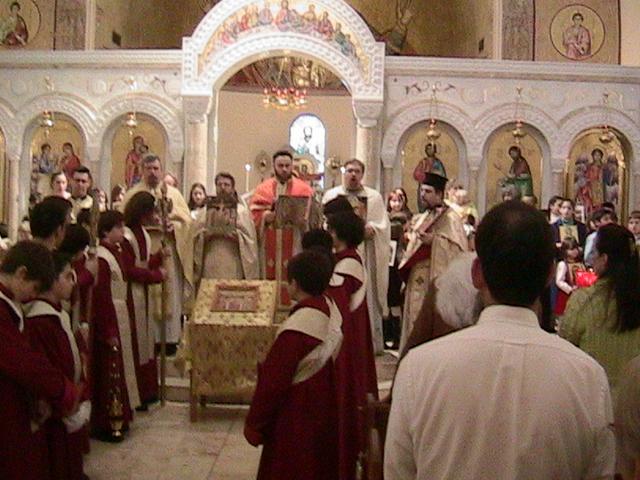
Going into an Eastern Orthodox Church for first timers can be a strange and even frightening experience. They come in and see the church, usually with low lights if they are arriving at the ending portions of Orthros before the Great Doxology begins, with its iconostasis, most people standing in prayer, the chanters chanting in some foreign tonal system, hymns with large chunks of theology that almost seem undigestable, the smell of incense, the doors behind which stand the altar are shut, a priest wearing lots of colorful vestments, etc.. How can one possibly feel "at home" during all of this? For a Western Christian or even non-Christian, it must take a lot to feel "at home" in this environment, Sunday in, Sunday out.

But such feelings of uneasiness are not just reserved for newcomers or even recent converts to the faith, but for Orthodox who have been baptized and raised in the faith all their lives. I see it every week. I see many of the faithful hanging on to their service books and their bulletins for dear life, as if the moment those are discarded, they will be totally lost in the actions of the Liturgy of St. John Chrysostom.

When you go to a house of a person whom you may not know very well, you are not given a booklet or an instruction manual or a rulebook (at least I've never received such when I visit new friends' homes!) on the every day goings-on at that particular household. You go there, you get acquainted and you soak it in. Such should be the way all of us should act when we enter an Orthodox Church, regardless of whether it is the Liturgy or an office being prayed. Go in and absorb.

The Eastern Orthodox are very very fortunate to have such a collection of prayer books and other aides for the spiritual life. Use them at your home, but when you come to the Lord's house, bring only yourself and resist the temptation to merely only follow along and not participate. Granted, you may only be able to participate very little for you may not know the hymns or the texts. It will come; give it time!

So many of our recent converts and people who have been Orthodox for years cling to their service books for dear life and then complain that they don't know their faith. As a teacher, I can tell you that you will never learn anything or make it a part of your very self if you are constantly using an aid. You cannot learn Latin or Greek by having a dictionary and/or phrase book in front of you all the time. Toss the service book for just one Liturgy or one Vespers. Get rid of it and allow all your senses to be uplifted by the divine action that is going on.

At the same time, don't expect to understand everything. If you were able to understand every nuance of the Divine Liturgy, there would be no need for one for we would be God. The Liturgy is God coming to us in the mystery of the Eucharist. We work collectively to feed our minds so that we can partake of the feast to feed our souls. You will be so much more hungry and so much more satiated if you would put away the animal crackers to get you through the Liturgy! Then you will be instinctively at home!

Just a few thoughts. Thanks again, Fr. Peters for some inspiration. I haven't had any for a while!

Tuesday, May 11, 2010

Commemoration of Sts. Cyril and Methodius, Equal ot the Apostles and Evangelizers of the Slavs. Also,a note on language


Today, the Holy Orthodox Church commemorates Sts. Cyril and Methodius, two Greek monks who were sent to evangelize the Slavic peoples in the ninth century to great success. The Prologue of Ohrid gives this description of them and their work:

Saints Cyril and Methodius were brothers from Thessalonica of distinguished and wealthy parents, Leo and Maria. The older brother Methodius spent ten years as an officer among the Macedonian Slavs and thus learned the Slavic language. After that Methodius withdrew to Mount Olympus and dedicated himself to the monastic life of asceticism. It was here that Cyril (Constantine) later joined him. When the Khazarite king, Kagan, requested preachers of the Faith of Christ from Emperor Michael III then, by command of the emperor, these two brothers were found and sent among the Khazars. Convincing King Kagan of the Faith of Christ, they baptized him along with a great number of his chief assistants and even a greater number of the people. After a period of time, they returned to Constantinople where they compiled the Slavonic alphabet consisting of thirty-eight letters and proceeded to translate ecclesiastical books from Greek into Slavonic. At the request of Prince Rastislav, they traveled to Moravia where they spread and established the devout Faith and multiplied books and distributed them to the priests to teach the youth. At the request of the pope, Cyril traveled to Rome where he became ill and died on February 14, 867 A.D. Then Methodius returned to Moravia and labored to strengthen the Faith of Christ among the Slavs until his death. Following his death - he died in the Lord on April 6, 885 A.D. - his disciples, THE FIVE FOLLOWERS, with St. Clement, the bishop at the head, crossed the Danube River and descended to the south into Macedonia, where from Ohrid they continued their labor among the Slavs begun by Cyril and Methodius in the north.

Sts. Cyril and Methodius are often invoked as the archetypal models for why the church should celebrate its respective services in the language of the place it is located. They did not evangelize the Slavs in Greek nor insist that their practice of the Orthodox faith should be done in Greek. This is in contrast with the Latin West who insisted that Latin would be the only liturgical language regardless of whether you understood it or not.

In orthodox churches today, there is some division on how best to apply this standard of using the language of the people in the liturgical language of the church. Obviously there is no 1:1 parallel between our time with that of Sts. Cyril and Methodius. There is a great deal more of mobility in today's world. You are not expected to die in the same place where you were born and lived. As a result, there are a great number of expatriates living in foreign countries where the language spoken is not the language of the church. Thus, communities of Serbs, Russians, Bulgarians, Romanians, Greeks will have their services mostly, or entirely in their respective mother tongues regardless of the fact that they are now in a new country. Often, they will insist that to remove the language in favor of the tongue of the new country amounts to nothing less than abandoning the faith itself!

Even further, the language that the Russians, Serbs and Bulgarians use is not Russian, Serbian or Bulgarian but Old Church Slavonic, the ancestor of modern Russian, Serbian and Bulgarian. The Greeks use not modern Greek but the Greek of the New Testament and the Byzantine Empire. Romanians use a more ancient form of Romanian. In other words, it is not the colloquial language. Attempts in Greece to use modern Greek for the Liturgy has been greeted with open hostility by the Holy Synod there.

Now, I have no idea what the solution to this whole problem is. This situation is not totally reserved to the Orthodox. German Lutherans for many years, even up until World War II, continued to celebrate the Mass in German. Hispanic Catholics here in the states continue to use Spanish for their Mass. I don't think however that all parishes in the United States should be forced to use English only or even use a combination of the two by their respective bishops or authorities. But I do think that those people who insist, often forcibly insist that for here in the United States it's English or nothing else, are wrong.

The insistence on using English only here in the United States for the liturgical language of Orthodox Churches betrays a fundamental misunderstanding of what Liturgy is and what it is not. The most obvious misunderstanding is this: Liturgy IS NOT Evangelism. The Liturgy is the worship of God in the Church (ekklesia) by those who have been called out (Enkalein) from the world. The language we use in the church should not be the same we use in every day life. If a church wants to use all English for English speakers fine, but that should not come at the expense of a Greek church whose members still want to use Greek because they pray in Greek.

Organic development has been the fundamental principle of Orthodox (small-t) tradition. If a group of Russians set up a church here in America 100 years ago and has used Russian for all of its services, it should continue to do so. But, if over time, more and more English works its way in, then it should continue unabated and organically. There shouldn't be someone with a clipboard and a checklist who stands by the priest and choir saying that since the Anaphora was in Russian last week, it should be in English this week.

I believe that Sts. Cyril and Methodius understood the organic development as well. They invented an alphabet for the Slavs but by no means did they immediately start celebrating the Liturgy in Slavonic. That took time. For those who wrongly insist that all Orthodox services be done in English for their sake (how arrogant can you get?), relax, go to your own English-speaking church and let it take time. Sts. Cyril and Methodius understood this; you should too.

May Sts. Cyril and Methodius continue to intercede on our behalf before the dread judgment seat of Christ.

Wednesday, May 5, 2010

Gifts and service

In my last post, I lamented that the choir at the church I attend is, unfortunately, not doing its duty as I think it should. Perhaps it is not even for me to say such a thing though it is clearly the elephant in the room. I also lamented that we have a great many people in our congregation who are gifted in some singing capacity yet will not join our choir simply because they too are frustrated with the knowledge of what goes on up in the choir loft when the choir is not singing. I posted a tract from Bishop BASIL who wrote that it is sinful (his word) for someone not to use the gift of his voice at the Liturgy.

At the same time, not everyone is gifted with a voice or an ability to make or even appreciate music. And that's OK. St. Paul tells us that we are all gifted in different areas. But too many people believe that their respective giftings should be translated to service only at the Liturgy. So, someone who is a good speaker should preach the sermon? Someone who is a polyglot should concelebrate and translate the service into other languages? Someone who is a good dancer should dance at the altar? Someone who is a gifted instrumentalist should play during the distribution? Of course, we would say no to any of such suggestions. St. Paul's listing of gifts should not be regarded as things that should be translated to the Liturgy. He is talking about our whole life in the church. And yet, it seems that there is a constant attack on the liturgy to somehow be "inclusive" of everyone and their respective gifts. If a person is a good and eloquent speaker, can not his skills be put to use outside of the liturgy? If a person is a good speaker of foreign languages, cannot his skills be used to translate the gospel for those who have never heard it? Why do people automatically assume their gifts are to be used only during Liturgy? Our life should be a spiritual one and yet we live most of our lives outside the church. Should we not employ our gifts there?

My thanks to Pr. Peters for good thoughts to inspire this little piece.

Choir and the Liturgy

I have recently quit the choir at my church. This is something that I really did not want to do, but I've finally come to the end of my rope. We are blessed to have a pretty talented choir which executes week in, week out pretty well and aesthetically pleasing. I can't tell you how many times people, who have moved away and returned to visit, have said that the choirs at their new churches are nowhere near as good as what we have. Such is a great compliment. But, like everything else in life, you have to take the good with the bad. Sunt bona mixta malis as we say in Latin. I wonder if we would still be complimented by these same people had they known what goes on when we are not singing.

I have quit the choir because I am tired of the incessant talking that goes on when we are not singing the responses or the hymns. I have quit because I don't have enough silence to pray the liturgy which I am trying to say. I have quit because many of the people up there do not take their duty (that's right, duty) seriously and come late, sometimes so late as to not arrive until after the Gospel reading, do not concentrate on what they are singing, do not concentrate on the rubrics, leave early so that only 4 people are left for the final "Amen", etc. In fact, many of the people up there are up in the choir loft so that they can talk to their friends and get away with it, something that would not be able to get away with if they were downstairs. Also, this choir does not rehearse and most choir members only want to sing the material they have done for the past 40 years! And then choir members wonder why no one new wants to join. Their own actions have prevented it.

So, I'm done. And yet, for all my righteous indignation, I know that I am guilty of a sin. Bishop BASIL once wrote up a very candid paper on the duty of singers. You can read it here. I have used the term "duty" referring to what choristers and chanters do deliberately simply because what we do on Sundays or any other Orthodox service or Liturgy outside of Sunday is a responsibility, is a duty. It is not optional for us. Those of us who are gifted to sing should sing! To neglect or to deny that gift is to cause grave offense to our Maker.

I don't like my choice. I would prefer never having made it. But I have and I must bear the weight of my sin. Though I will continue as a chanter, to deny my voice at the Liturgy which is the work of the people, I am imperiling my own salvation. I do want things to change up there but I'm not so arrogant as to think my departure will change anyone's habits. Most of the people up there have been up there for a long time and such habits will not change overnight.

Saturday, May 1, 2010

The future of the Western Rite in the Orthodox Church

A week ago I had a brief conversation with a friend of mine who is a catechumen at our sister church here in Omaha, St. Vincent of Lerins. St. Vincent is a Western Rite Parish of the Antiochian Archdiocese. Before, I get into what the conversation was about, let me give some background on the Western Rite.

Currently, only two jurisdictions in this country have Western Rite Vicariates, the Antiochians and the ROCOR (Russian Orthodox Church Outside of Russia). Most Orthodox Christians worship according to the Eastern Rite, which revolves around the Liturgy of St. John Chrysostom. Western Rite Orthodox Christians use either the Rite of St. Gregory the Great or that of St. Tikhon. The latter was an emended form of the Rites used in Anglican Churches. St. Tikhon saw nothing unorthodox about it but made some changes, most especially in the canon, and it was pronounced Orthodox. Thus, many Roman Catholics as well as High Church Episcopalians and Lutherans will find that the Order of Service for a Western Rite Orthodox Church is very familiar to their own rites.

The Western Rite is not without controversy. As I said, only two jurisdictions here in America (and probably for the world) offer the Western Rite. There are many, both cradle and convert, both layperson and clergy who feel that the Eastern Rite is the only Rite for Orthodox Christians. Some say that Western Rite Orthodox Christians have yet to embrace the fullness of the faith and the church. I shake my head at such accusations. We must remember that there were a number of "competing" liturgies even in the Byzantine Empire. It was not until the 8th century where the Liturgy of St. John Chrysostom was made the "usual" practice thus sidelining the Liturgy of St. Basil the Great, which is now used only about 10 times a year. We must also remember that the West (as a whole) was Orthodox until about the 10th century when diversions from the true faith such as the filioque, azymes, different baptismal practices and the doctrine of papal infallibility would cause schism later. Nonetheless, the Western Rite, developed long before these innovations came into practice is Orthodox, in its theology, in its prayer. Granted, those innovations I mentioned crept into the prayers but those, for a modern Western Rite, can be easily excised.

That is not to say that I am all keen on the Western Rite. For instance, some ceremonies and feasts have been retained that lead not only to split between east and west, but also to the Reformation. The feasts of the sacred heart, the immaculate conception, corpus Christi have been retained and these are problematic.

Now, back to my conversation. My friend is an Orthodox catechumen. He was enrolled as a catechumen at St. Vincent of Lerins. Catechumens are required to go through an exhaustive preparation before they are received into the Church. This is done for their benefit. It is all the craze now to go "church shopping." The catechumenate exists so as to eliminate any doubt that this is just a passing thought in his/her mind. Anyway, as preparation, catechumens go to classes, attend the Liturgies and as many other services as they can to accustom themselves to the lex orandi, lex credendi of Holy Orthodoxy, and also read a lot of books. These catechumens are reading Bishop HILARION's (now Metropolitan) book "The Mystery of Faith." It is an excellent book, but like all books on the faith of the Eastern Orthodox, it relates the faith through the Liturgy of the Eastern Rite exclusively.

The Liturgy is our great teacher. It is not something we dispense with simply to go with something more hip and more "relevant." It is our great teacher and has been for a long time. The problem is that with all the books out there about the Eastern Orthodox faith, they all reference our faith through the lens of the Liturgy of St. John Chrysostom or Basil the Great. This poses a problem for our Western Rite catechumens who, desiring to learn the faith and process it and make it part of thesmeslves, cannot make connections between what they read and what they experience in the Western Rite.

Thus, there is a great need for books to be published on how the Orthodox faith can be grasped and apprehended through the Western Rite just as through the Eastern Rite. Sadly, nothing as yet exists. And, if there is no remedy, I fear that the Western Rite for Orthodox may disappear altogether. And that should not be allowed to happen.

As for my friend, he has decided to complete his catechumenate at St. Mary which uses the Eastern Rite. He was originally to be chrismated at Pentecost, a few short weeks away, but now his chrismation and his entry into the church will be delayed for a little longer. He has decided upon this course because, whether rightly or wrongly, he experiences the fullness of the faith only in the Eastern Rite. The lack of adequate reading materials to help him and others complete his journey in the Western Rite needs to be given great attention.

At the same time, I feel that this is not an isolated case. Western Rite parishes are very hard to start up and maintain here in America. And many Western Rite parishioners have come over to Eastern Rite churches because they feel that the Eastern Rite is, to them, "more Orthodox," whatever that may mean. It would be a great shame and sadness if the Western Rite were to disappear. I hope someone would take it upon himself or herself to write about how the Western Rite Liturgy is just as Orthodox as the Eastern Rite; to demonstrate how the Western Rite reflects and practices Orthodox spirituality through its Liturgy. That needs to happen sooner rather than later.

Monday, March 1, 2010

The Liturgy as a Family Reunion

We are now starting the third week of Great Lent and the Fast. It is now where I am beginning to struggle with the fasting and the additional prayers. It's not because I am bored with them or feel that they are ineffective but because I am genuinely tired and worn out. Prayer, true prayer, is a herculean effort and to compound it with fasting on top of normal daily activities and the fact that time has not increased for a given day only adds further to the struggle. But, of course, if we contend only as individuals, we are bound to be tired and worn out. Sinners are condemned alone, but the saved are saved communally. The Lenten struggle is ameliorated since all that we do and all that we should do is supported by our family, i.e. our fellow Orthodox Christians...at least in theory.

This past week I had a brief discussion with a friend of mine who was noticeably disillusioned by the lack of attendees at the presanctified Liturgies on Wednesday. I could see that he was clearly bothered that no more than about 20 people have attended each service thus far. I, of course, tried to answer his negative assessment with some of the old tried excuses such as Lent began so early this year, it's still very cold out, people are still getting out of the Christmas mode, etc. I was really not trying to justify people being gone, but, every year, it is a fact taht most people simply do not want to come. It's not important to them. It's as simple as that. The conversation naturally steered to how we get more people to come out. It was at this point that I felt that the conversation would only exascerbate already disappointed feelings so it ended abruptly.

I'm sure that at this time, every church, at least every church that observes the Lenten season even in some reduced fashion, is wondering where everyone else is. It is a conversation that will always be held. To try and come up with solutions to this problem is too much to get into and I won't attempt such a feat here.

But in the conversation, my friend repeatedly referred to his St. Mary family. Now, this is by no means a unique or unheard of description about the church membership, but it got me thinking that the Liturgy is a family reunion. It is not a gathering of us Orthodox Christians and our brothers and sisters in Christ, but also the gathering of the saints gone before us who congregate together to sing with the angels the praises of God.

Every family reunion though has its share of people who cannot simply make it, for whatever reason. Yet the reunion goes on as planned. With our Liturgies, the prayers still go on, the Word is still preached, we are forgiven, we are encouraged and we are given the life giving medicine of the Eucharist. All these things still happen! And we rejoice that they do. We may take note of our absent brothers and sisters but if this becomes our focus, like it seemed to with my friend, then what is the purpose of participating in the work of the people in the first place? There is none.

Rather than be sad at the family members who are absent, we should all the more rejoice at those family members who are mystically there. Pray for those absent, but rejoice with those present. Do we only go to parties to talk about those people who aren't there? Why should we go to the Liturgy and do that same thing? We are in the presence of God, where the boundaries of Heaven and Earth mystically fade away so that we are enveloped totally by God. And that is completion enough.

We can proceed through the rest of the fast faithfully and with reverence knowing that we do have good support from our family that is present. We are encouraged by their prayers and exhorted by their examples. Thus, we persevere. There are always more than enough at the Liturgies and Offices to help and compensate for the many who are not present, for whatever reason.

To my friend, if you read this, I mean no disrespect. As I have said before, I am of like disposition, but I think we need to see the bigger issues.

Thursday, December 24, 2009

The Vesperal Liturgy of St. Basil the Great


Today, we began our preparation for our Lord's coming with the chanting of the Royal Hours, each with their three psalms and Scripture readings from the Old Testament, an Epistle of St. Paul to either the Galatians or Hebrews and the Gospel accounts of Christ's birth.. Anyone who dares think that we Orthodox don't reverently treat or read Scripture within our own services doesn't know what he is talking about. Then we proceeded into the Vesperal Liturgy, which I never had the privilege to chant before. It was glorious. The history of our creatin, decline and the prophecy of our salvation rang through the eight selections from the Old Testament. Then we moved to the Liturgy.

The feast of the Nativity is odd, at least liturgically. Only on Nativity and on Theophany can a Liturgy be celebrated twice (once as part of Vespers and then following the Orthros) for the same Liturgical day. It is magnificent. What is even more magnificent is that the Liturgy following Vespers is not of St. John Chrysostom, but that of St. Basil the Great. St. Basil's Liturgy is only served about ten times a year (Vesperal Liturgy on Nativity Eve, Vesperal Liturgy on Theophany Eve, on St. Basil's Day, the five Sundays of Great Lent, Holy Thursday and Great and Holy Saturday). It is rather unfortunate that we as Orthodox, especially who are not clergy do not to get to hear and pray the wonderful anaphora of this liturgy because it is served so seldom.

Here is the prayer of the Anaphora following the Sanctus:

With these blessed powers, O Master and Lover of Mankind, we sinners also cry out and say: "Holy are You, truly all-holy!" There is no limit to the majesty of your holiness. You are revered in all your works, for in righteousness and true judgment You have ordered all things for us. When You created man and had fashioned him from the dust of the earth and had honored him as your own image, O God, You set him in the midst of a bountiful paradise, promising him life eternal and the enjoyment of everlasting good things by keeping your commandments.

But when he disobeyed You, the true God Who had created him, and was led astray by the deceit of the serpent, he was made subject to death through his own transgressions. In your righteous judgment, O God, You exiled him from paradise into this world and returned him to the earth from which he had been taken. But You provided for him the salvation of rebirth which is in your Christ Himself.

For You did not turn Yourself away forever from your creation whom You had made, O Good One, nor did You forget the work of your hands, but You visited him in different ways. Through the tender compassion of your mercy, You sent forth prophets. You performed great works by the Saints who in every generation were well-pleasing to You. You spoke to us through the mouths of your servants the Prophets who foretold to us the salvation which was to come. You gave us the Law to aid us. You appointed angels to guard us. And when the fullness of time had come, You spoke to us through your Son Himself, through whom You had created time.

Being the Brightness of your Glory and the Stamp of your Person, and upholding all things by the power of his Word, your Son did not think of equality with You, Who alone are God and Father, as something to be grasped. And so, although He was God before time began, He appeared on earth and dwelt among us. He was incarnate of a holy virgin and emptied Himself, taking on the form of a servant and being conformed to the body of our lowliness so that He might conform us to the image of his glory. Since sin entered the world through a man and death through sin, so your Only-begotten Son, Who is in your bosom, our God and Father, was well- pleased to be born of a woman, the holy Birth-giver of God and ever- virgin Mary. He was born under the Law, so that He might condemn sin in his own flesh, so that those who died in Adam might be made alive in Him, your Christ.

He lived in this world and gave us commandments for salvation. He released us from the delusions of idolatry and brought us to the knowledge of You, true God and Father. He procured us for Himself as a chosen people, a royal priesthood and a holy nation. Having purified us with water, He sanctified us with the Holy Spirit. He gave Himself as a ransom to death by which we were held captive, having been sold into slavery by sin. He descended into the realm of death through the Cross, that He might fill all things with Himself. He loosed the sorrow of death and rose again from the dead on the third day, for it was not possible that the Author of Life should be conquered by corruption. In this way He made a way to the resurrection of the dead for all flesh. Thus, He became the first-fruits of those who have fallen asleep, the first-born of the dead, that He might be first in all ways among all things. Ascending into heaven, He sat at the right hand of your Majesty on High, and He shall come again to reward each person according to his deeds.


Where else is the Gospel so well expressed in our liturgies or prayers? Where else is the history of our salvation so laid out with such optimism and trust in an ever compassionate and loving God? Where else do we hear such profound depth as shown by the emptying of our God to become as we are? The answer is: no where, or at least I can't find it.

I love this prayer of the Anaphora of St. Basil. The opportunity to offer this prayer to God in behalf of all the people is almost enough to make me want to be priest save for the fact that I am unworthy to even consider such a calling in life.

Glory to God for all things! Christ is Born!

Tuesday, September 22, 2009

I don't think a title conveys what is going on here

As much as I complain about the Liturgy in the EO, that it's not reverent enough, that too much is omitted, that there is such a rush to get things done, etc. at least we haven't descended to this point...and I hope we never do.

Sunday, September 20, 2009

This bugs me


Call me a liturgical purist or just anal retentive, I don't care. One of the underlying characteristics about the worship of the Eastern churches is that the worship is conducted while standing. Most Orthodox do not, or cannot, stand for the entire Liturgy, which for some people is completely understanding, but for healthy people, there really is no excuse. To sit is to assume a position of comfort and it makes one lazy and slothful especially when you are to be praying. Besides, everyone knows the expression "Think on your feet." Well, your response time improves by more than 20% when you are standing and that is especially useful in prayer. I know that I really should only be concerned for myself, but I get irritated when sitting is preferred and then I'm told it's allowable because it's an Antiochian tradition, which is code for, we're modern and hip so we don't have to do it the old way. I know I will always be on the losing side of this battle, but I will continue to fight. Here is a brief list of when people generally sit when the congregation SHOULD be standing during Liturgy or any of the offices.

1) The Litanies. You are asking our Lord and God and Saviour for mercy and forgiveness. How does the sitting position convey that you are sincere and earnest for mercy for your sin-laden soul? Stand up!

2) The Six Psalms at Orthros (Matins). I grant that very few people ever come to Matins on a Sunday or a feast day, but when we serve Orthros in the evening during Holy Week for the following day, or on Christmas Eve (which shouldn't be done anyway), you should be on your feet. The six Psalms are 3, 37, 62, 87, 102 and 142. In our tradition, one should stand for these Psalms with heads bowed. Making of the sign of the Cross at the break between pslams 62 and 87 when we chant "Glory be..." and "Alleluia" is wrong becuase we should be focussing on our sinfulness and the mercy of God. These are the psalms that our Guardian Angel will read at the Last Judgment when we stand before the Dread Judgement seat of Christ. You should be preparing for that awful day. You're not going to find a chair for you to sit in when Christ is presiding. Stand up!

3) Any time the priest censes. Whenever the priest comes out of the Holy Doors whether at Psalm 140 for Vespers, the imperial psalms and troparia of Matins, the singing of the ninth ode (Magnificat) at Orthros, the final censing of the Proskomeide (preparation of the gifts), the Cherubimic Hymn, etc. you should stand and have your head bowed. You are an icon of Christ. As the priest censes the icons on the iconostasis in the front of the sanctuary, so he also censes you. Why? So that your prayer will be uplifted to God. It is also improper to make the sign of the Cross as this happens. Stand up!

4) Whenever the priest blesses you in the name of the Trinity. Stand up!

5) During the reading of the Gospel and the Alleluia verses. Stand up!

6) During the Cherubimic Hymn and the Anaphora. Stand up!

7) The Little Entrance (with the Gospel) and the Great Entrance. Stand up!

8) The Lord's Prayer. Stand up!

9) The pre-communion prayer of St. John Chrysostom. Stand up!

How does that old Protestant hymn go? Stand up, stand up, stand up for Jesus? If you get tired, sit down. Christ doesn't expect you to kill himself for the sake of the Liturgy, but if you have the wherewithal and the strength, you should stand and make a little room for sitting as possible.

Also, as a side note, it is also improper for one light candles and venerate the icons as the priest is censing.

Why has this lack of liturgical etiquette crept into Orthodox Churches (not all of them mind you)? It's probably because of a lack of good catechesis and education of the faith (especially among the cradles, though the converts are to blame as well). There's probably also a hint of Orthodox trying not to appear as radically different from the typical American mainstream Christianity. Whatever the reason may actually be, just stand up. For people who complain consistently that they "don't get much out of the service", this may be the prescription to cure that malady.

Saturday, September 19, 2009

Does the Liturgy work?


I have to commend Fr. Peters over at his blog, Pastoral Meanderings for his incisive comments regarding the Liturgy. As Orthodox, we are relatively immune from the so-called "Worship Wars" which have torn at the heart of various Protestant denominations, including the LCMS (Lutheran Church-Missouri Synod), into which I was born, baptized and confirmed. The LCMS is definitely divided among those who practice and pray the traditional Liturgy and those who would prefer to do whatever they want. Liturgy was relegated to the status of adiaphora (open question) by a great many LCMS pastors to the point that almost no Lutheran churches served the traditional Liturgy because they would give in to demands that the traditional Liturgy no longer spoke to the mass of people.

Fr. Peters knocks this out of the park. Even for Orthodox who insist that we need to get rid of the traditional Liturgy of St. John Chrysostom and replace it with something shorter (because 1.5 hours is way too much), Fr. Peter addresses their complaint thus:

Is it [i.e. Liturgy] working? If the Church is still here, if people are still being fed the Word and Supper of the Lord, if sins are still being forgiven, if creed still invites confession of faith before the world, if sermon still conveys the whole truth of God's Word and if music still speaks the story of Jesus (and not our own personal stories), then it IS working -- better than we know -- to keep us on that narrow path that leads us to life everlasting in Jesus' name.

You can tell Fr. Peters is Lutheran. But these words are applicable still.