Monday, October 31, 2011

Reformation Day 2011


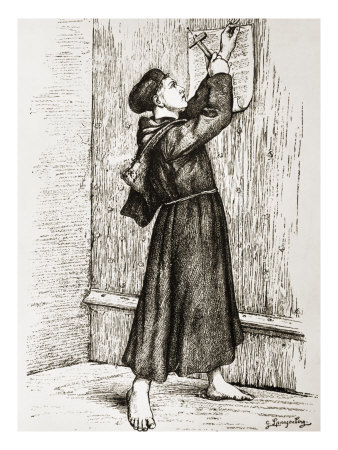
On October 31, 1517 (old calendar) a young priest by the name of Martin Luther nailed his 95 theses to the cathedral door of All Saints Church in Wittenberg in the duchy of Saxony. All over the world, Lutheran churches are paying homage to their founder and many other reformed churches which owe their own existence to this act of defiance.

I was raised Lutheran and I admit that I was not spiritually happy in the Lutheran tradition or what has become Lutheran tradition. So I left and I have no regrets about doing so. The only thing that I do regret is that in my own zealousness and desire for self-justification and self-vindication I have been less than charitable many times towards continued adherents and even converts to the various reformed churches. This does not mean that I cannot engage in debates of substantive concern with regards to Christianity.

Reading some articles today about the Reformation and how churches are celebrating, I came upon an article by Paul McCain, who is a Lutheran pastor and has his own blog, Cyberbrethren. I will admit that I have had several confrontations with him and I will further admit that I do not much care for him personally. His destructive rants against anyone who has left the Lutheran church have damaged the reputations of many good people. I also have some qualms with him on academic integrity, but those are not the issues. On his blog, today, McCain writes what it means to be Lutheran. He writes, "To be Lutheran is to be a person who says, 'This [i.e. Lutheranism] is what God’s Word, the Bible, teaches. This and nothing else is true and correct.'"

His description highlights one of the main reasons why I left Lutheranism. As a Lutheran in catechism class I was taught the three solas: sola fide, sola gratia, sola scriptura. As I studied and read more I found that the last, sola scriptura, was not only historically untenable, it is theologically untenable. Sola Scriptura is also the wrong answer to the wrong question. Lutherans ask "what is the Word of God?" They should ask, instead, "Who is the Word of God?"

The Word of God is NOT the Scriptures. The Word of God is Jesus Christ, the second person of the Holy Trinity who became man. The Scriptures, or Bible, if you prefer, are the witness to Christ. The Scriptures are an icon, an image, of God, but no one would say that they are God. Such a position would be rightly denounced as ridiculous. But the reformed tradition's insistence on sola scriptura replaces Christ as the head of the Church with a book. Catholics go in the other direction and replace Christ as head with their pope. The Lutherans, and other Protestants, did a 180 but are still in error.

This issue was not the driving force behind my leaving, but it is important. I wanted to engage in a practice that fed my soul. I read my histories carefully about the importance of asceticism, fasting, starving the passions, vigilant prayer, worshiping with the Liturgy and offices in the early church, all things which were considered unnecessary by my Lutheran teachers, even condemned because they were not "prescribed in the Bible." Sola Scriptura threw out such good practices and disciplines which I only found and have applied (though poorly) since I became Greek Orthodox. I think that if Lutherans would examine their own history, they would find that the practices I mentioned above were still retained by the Lutheran churches until Pietism in the eighteenth century reared its ugly head.

Luther made some very necessary demands on the church of the west at the time. They were largely ignored and schism ensued, but I think Luther would even have a hard time identifying the Lutheran Church of today (in its thousands of manifestations)as the heir to what he taught. But I know that I could only have become Orthodox if I was Lutheran first. For that, I am very thankful.

Quote of the day

There are only two kinds of men: the righteous who think they are sinners and the sinners who think they are righteous.--Blaise Pascal, French mathematician and Catholic philosopher

I think this adequately sums up Christ's parable of the Publican and the Pharisee.

Saturday, October 15, 2011

What does it mean to be religious?

I've never cared for the word "religious." Frankly, I think that as the term is applied specifically to Christians, it really does a disservice. The root of the word religion, lig comes from the Latin ligare which means to bind or fasten to a set of rules or conditions. (As a side note some etymologists have suggested that the root word lig is a corruption of the Latin word lex, legis which means the law). Whatever its proper derivation, the term means almost nothing today. The term is applied to the person who attends services and prays unceasingly and tries to live a holy life as well as to the boastful sinner who still goes to church on occasion, does charitable works, but does almost nothing to live a Christlike life.

Take, for example, Ms. Sara Leal. For whatever reason, Ms. Leal felt it necessary to give a very explicit narrative to the New York Post regarding her night of passion with not-yet-divorced actor Ashton Kutcher (i.e. Kelso from "That 70s Show"). If you do link to the article, you've been warned! In between sex sessions, the conversation with Kelso, I mean, Kutcher, the subject turned to politics and religion. According to Leal, she told Kelso that she was a religious Lutheran from Texas. Following that, they returned to their entertainment. So, to Leal, what does religious mean?

We are all sinners in this fallen world and have fallen waaaaaaaaaay short of the glory and mercy of our Lord, but should any of us be trumpeting ourselves as religious especially in the midst of any kind of debauchery? I'm in the middle of reading Uncle Tom's Cabin and I see the same type of characters who view themselves as good religious men while at the same time perpetuating the cruel and demeaning institution of slavery. For those of you who have seen the Godfather, you remember the scene that as Michael Corleone is sponsoring his nephew's baptism and renouncing the ways of Satan, his men are carrying out his orders to murder his competition. It's hypocrisy at its finest.

Only God can judge but we should still know what sin is when it's readily visible before our very eyes. And yet, despite that, even when we are in the midst of our own sin, we take comfort that we are still "religious." Perhaps the late Fr. Romanides was right when he once remarked that religion is a neurological disease. Religion seems to be the expression of our cognitive dissonance from what we know is right and God-pleasing to our actions otherwise.

Maybe we should just jettison the term "religious" for something else. Or, better yet, we should reclaim it and make sure it has one certain definition: Living as Christ would want us to, getting up once we have fallen, repenting and hating our sins rather than indulging in them. Easier said than done? Of course, but that's why there is always the grace of God.

Sunday, October 9, 2011

Mitt Romney's Christianity

Courtesy of a friend of mine. Thanks, Bill.

Concerning the issue of Mitt Romney's Christianity: there was a time in my life, when I followed Christ in an unorthodox manner, that I would have quickly explained how he couldn't possibly be "a Christian". However, since I have been following Christ in an orthodox fashion, I have had to realize that every moment I spend considering someone else's "Christianity" is a moment I should have spent attending to my own faults!

Lord Jesus Christ, Son of God, have mercy on me a sinner......

Sunday, October 2, 2011

Patristic Quote of the Day

We can know what God is not, but we cannot know what God is.--St. Augustine

I challenge any Orthodox person, lay or clergy, to substantiate that Augustine is not an ardent defender of the apophatic theology of the Eastern Churches. Granted, one quote is not enough to prove anything, but I believe that those among the Orthodox who have labeled him as an extreme Western cataphatic theologian (like Fr. Romanides) have never really read Augustine.

Wednesday, September 28, 2011

Stop passing the offering plate


Another blog I frquently read has a tongue-in-cheek diatribe about maybe getting rid of the time honored practice of passing the collection plate during church services. The blogger remarked that doing this every Sunday robs it of how offering our own gifts, meager as they are, like the woman who offered only two mites compared to the lofty sums of gold paid by the wealthy, is a reflection of our love for God. Now, he went on further to say that other "every Sunday" acts like the recitation of the Lord's prayer, a sermon, reading the Scriptures, etc. should also go because if those acts are present every Sunday, they will become "less special." Needless to say, the person who wrote this is NOT an Orthodox.

But, why not stop the practice of passing around the plate? In my parish, only on Sunday Divine Liturgies are the collection plates passed. This is never done at Vespers or on weekday Liturgies or services. And that may be due to the fact that there are few people there in the first place. Still, why not stop this entirely? The collection plate is always passed at my church during the singing of "Axion os estin" (It is truly right). Granted that this hymn is well known and is sung at more than the Divine Liturgy, but how many people are distracted by opening their wallets or purses to find some money to put in there? And how many more people are distracted by wondering when the plate will get to their location? They are not focusing on the words of the hymn, which invariably sums up our Incarnational Theology that God is With Us, but focusing on the money we give to the church.

My question: If this practice were to stop altogether, would people then forget to contribute their pledges and tithes? If it wouldn't, then why continue with it? It's a needless distraction.

I'm probably going to be in the minority on this one and I'm not trying to disparage giving back to our Lord, but why must it be done in a way which not only takes away our attention from the Divine Liturgy, but also could encourage people to judge others (look at that person; he didn't put money in the tray. Sinner!). I'm going to bring this up at the next voters meeting and see how much traction this will gain. I'm sure it will be laughed at or just dismissed, but I've always believed in lost causes!

Saturday, September 17, 2011

Just Divorced


Sorry for the confusing title, but I am not just divorced; it has more to do with the picture I posted which a friend of mine took. Heck, I am still in that zone of "just married."

It is still one of those "traditional" things that married couples, having immediately taken their nuptial vows, immediately speed away in a car with the motto "Just married." People are supposed to see that and honk with approval or give the newly weds a thumbs up or something. I'm grateful that my wife and I decided not to go for that tradition. However, the people who opt to do such a thing probably only do so because they are happy and want everyone to share in their happiness. There is nothing wrong with that but that wasn't for me.

The picture, which a friend of mine posted on her facebook page, shows a car with a "just divorced" slogan painted with various decorations. Now, I do not know the person who put this up on the car (it may well not have been one of the divorcees, but maybe a friend who thought it funny), but why would one exult in something which is not a good thing? Divorce may be necessary, but necessary does not always equal good. I'm thankful the Orthodox Church has not gone the way of the legalistic Roman Catholic Church and prohibited divorce for any reason. But, even in the Orthodox Church, a divorced man or woman is excommunicated for a brief time and repents because even if one party was not really "at fault" for what happened, marriage is a two way street and, hence, both are responsible.

This form of exultation in divorce may be novel but the fact is many celebrate divorce with "divorce showers" and parties. Many consider it to be the "best thing that ever happened to them." I remember when I was a pawn broker for a brief time. If a woman or a man wanted to sell engagement rings and/or wedding bands, I would always ask why. The point of the question wasn't to be nosy or get into their personal business, but if I was taking stolen merchandise, both the store and I could be in big trouble. My probing questions would almost always ascertain the reason for selling was due to divorce and they didn't need the rings anymore. As a form of habit, I would always say "I'm sorry." And they would almost always reply the same way that it was "the best thing that happened to them." After hearing that so many times, I asked myself if they also thought of their marriages as "the best thing that ever happened to them."

We live in a society that is increasingly celebrating bad things. We have contests to see who can eat the much and reward them. We have records for how long your fingernails are. This is not news, but promoting and celebrating divorce in the same way we promote marriage is a far cry from celebrating who can eat the most pies in 10 minutes! Everyone has their own scheme for hitting the snooze button on their 15 minutes of fame.

I have no brilliant insights as to how to curb these trends. And I don't think that if other confessions of Christianity start to regard and treat marriage as a a sacrament will the epidemic of divorce cease. I don't know the statistics but I don't believe that the rate of divorce among Orthodox Christians is any higher or lower than that of Evangelicals, mainline Protestants or Roman Catholics or even among Americans as a whole, regardless of religious conviction or confession.

I do know this though. Marriage is sacrifice of a spouse to the other for the sake of Christ. It is a martyrdom of sorts, which is why the Orthodox sing hymns of the martyrs and why St. Stephen the Protomartyr is invoked at the dismissal. Though divorce may be necessary for abuse, infidelity, and other breaches of trust, divorce is turning inward towards oneself. I-thou is replaced with I, me, mine (apologies to George Harrison). Love is replaced with indifference. But, of course, there is remedy for such inward turning--repentance through Christ our Lord.

Let us rejoice in only what is good. Marriage is right and honorable and blessed and good. Christ Himself was a celebrant of marriage during his earthly travails. It was at the Marriage of Simon the Zealot at Cana where Christ performed His first sign or miracle, the changing of the water into wine. Divorce may be necessary, but never good and never worthy to be praised as such.