Saturday, December 17, 2011

Happy Birthday, Beethoven


Yesterday, December 16 is the date ascribed to the birth of Ludwig van Beethoven in 1770. The son of a musician at the court of Bonn, Beethoven early in life was marked out for musical greatness. In many ways, a prodigy like Beethoven, though lacking the resources that were available to Mozart in addition to having a father more in exploiting his son for profit, Beethoven nevertheless bloomed and was at the age of 13 given musical composition instruction by the court organist, Christian Gottlieb Neefe.

The rest of Beethoven's life can be read online, if you should choose to go further. Unlike Mozart and Haydn, the two giants who preceded him, Beethoven wrote comparatively little for the church. Mozart and Haydn both had powerful patrons in the church throughout their lives and demanded the composition of sacred music for their courts or name days of their employers. Beethoven wrote two masses, one in C major and the Missa Solemnis in D.

The Missa Solemnis follows in the tradition of Bach's B Minor Mass or Mozart's Great Mass in C minor in that is on a grandiose scale, though not in the "cantata" form. This work was written for his pupil and friend, Archduke Rudolf who later was appointed Prince-Archbishop of Olomouc which is in Moravia. The earlier Mass in C major was written for the name day of the wife of Prince Nicholas of Esterhazy. Haydn was formerly in the employ of the Esterhazy family, but Haydn was now touring the world and Haydn, being a former teacher of Beethoven, had probably secured for him this commission.

The Mass in C major was a huge disappointment. The performance was horrible mainly because the musicians resented to having to take directions from a deaf composer. The court composer, Hummel, was publicly reprimanded by Prince Nicholas for failing to keep the musicians in line for rehearsals.

The failure of the performance probably kept Beethoven from writing other sacred pieces and probably also contributed to its scarce performance today. His only other attempt in the "middle period" was his Oratorio, Christus am Olberge (Christ on the Mount of Olives). Unlike the Oratorios of Handel, Beethoven set a theme from the New Testament. This work,too, has suffered a lack of performance. It has many great gems, but they are not widely known. The Missa Solemnis, despite its greater recognition, is still not performed with any frequency today simply because of the scale of the work and its massive orchestration (the orchestration from the 9th symphony is even smaller).

It is lamentable and sad that the music written for the Western Rite churches have fallen into obscurity. Most churches today lack the necessary musical forces to perform classical works. And today, the only time one may hear a mass of Beethoven or Haydn or Mozart or even Schubert is in a concert hall and not in a church. Of course, many would argue that such music is distracting and does not center on prayer. Of course, such people who make the charge favor the "praise band" style; now THAT IS DISTRACTING!

I would encourage you to listen to the Kyrie from the Mass in C. It starts out slowly and subdued with a plea for mercy. But, as it grows in intensity and dynamics, it never becomes arrogant or haughty. It begins softly; it ends softly. The music never overpowers the plea for mercy, but it serves the text.

I can only wonder at what great works Beethoven may have written for the church had he lived longer and some circumstances in life were different. But what he did leave are gems and should not be cast aside. Though he will continue to be known and praised for his symphonies and his sonatas, his contributions to the sacred should receive due attention as well. Happy birthday, Beethoven, greatest of composers!

Tuesday, December 13, 2011

Suffering and the Christian

Has today's modern Christian forgot (or perhaps never learned in the first place) about how to suffer? Every day we are plagued with reports about suffering and yet we do everything we can to insulate ourselves from the very real possibility of suffering ourselves. And then when we do suffer, we cannot lift ourselves from it, but instead entrap ourselves in a never ending cycle of "woe is me!" and self-pity that only exacerbates it and allows the suffering to persist.

As Christians, we should expect to suffer. Christ Himself said that to follow Him was to take up the cross. He also called those who suffer for His sake blessed in the Sermon on the Mount. St. Paul, perhaps the architect of what it means to suffer in the Christian tradition, says in his epistle to the Romans (8:17) that to be heirs of Christ is to be a co-heir in His sufferings. Fortunately, St. Paul doesn't end there but continues, saying that the result of such sufferings is ultimately that we be co-glorified with Him. Suffering leads to salvation and, as such, requires us to have joy in it. But, modern man and particularly, the modern Christian say, "I'll take the joy, but hold the suffering." But when the inevitable suffering comes, the modern Christian has no idea what to do or how to cope.

The assault on suffering comes from both within the Christian community and without. Liberals and statists, in their good intentions to make the world into one that is free of pain, are the first set of culprits. Today's liberals and statists, following precepts like this one uttered by President Kennedy--"man holds in his mortal hands the power to abolish all forms of human poverty"--are only treating the symptoms. For today's liberal, there is no sin, which is the cause of suffering, but there is only an anomaly which can be wiped out by reason and scientific inquiry and social legislation. I've yet to see any social legislation that has eradicated the poverty of the intellect, i.e. stupidity. Like most of the agenda of liberals, the cure is not the concern, only the managing of outbreaks of symptoms. It is like giving aspirin to relieve the pressure in the head caused by a tumor. They will not strike at the tumor, but only the pain.

A second assault on suffering comes from within the Christian churches, who, like today's secular liberals and statists, insist that sin is not the problem, going out of their way to deny it. This group is represented by mainline Protestants who have swapped the Gospel for the leftist agenda while insisting that Christ would approve. Sin never enters the equation. And if there is no sin, there is no need for repentance, a complete change of self. So, for those who subscribe to this "christian" belief system, suffering is also an anomaly, but the solution is to treat the symptoms in the same manner as the statist.

A third assault on suffering comes again from within the Christian churches who teach that suffering is given to you because you don't have enough faith in Jesus Christ. Once you do have faith in Christ, your suffering will end and you will have joy in the form of riches. This is the message of the Prosperity Gospel, peddled by Joel Osteen and Rick Warren. For them, suffering and joy are not complementary but outright opposed and hostile to one another. One moment, you suffer; the next, you rejoice. Never is it both at the same time. But riches are not true happiness and joy. In effect, people who buy into this belief, do not attend to the soul.

(Side note: The acquisition of riches was never a promise to make men happier and to end suffering. True classical liberalism, represented by laissez-faire economist, Adam Smith, would never go that far. Material wealth is good in that it allows some physical miseries like disease and hunger to be dispensed with, but the debilitating psychological and spiritual miseries remain with which to do battle).

To want to do away completely with suffering is egoism at its finest. Misery cannot be abolished by reason or social legislation. Nor can it be blotted out by simply ignoring the root cause of sin. Nor can it be removed by simply acquiring riches since other miseries will still remain. Suffering must remain part of modern man's raison d'etre or sine qua non.

"What earthly joy remains untouched by grief? What glory stands forever on the earth?" writes the church father, St. John Damascene. It is not coincidental that these words are sung at Orthodox funerals. Our sufferings have to go hand in hand with our existence. But, there is the hope of salvation through sufferings in the person of Jesus Christ. It does not necessarily require actually being physically tortured as Christ was, though many martyrs have gone that route. But, for Christians, if our goal in life is to join ourselves to Christ, then we must start imitating Him. Wanting to cast aside sufferings or only treat the symptoms or deny the root cause is nothing more than conceit and arrogance. If we do that, then why celebrate at all the coming of Jesus Christ in the flesh?

Saturday, December 10, 2011

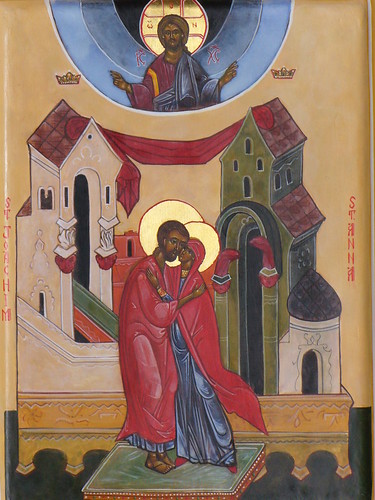
Conception of the Theotokos


On December 9, the Holy Orthodox Church, commemorates the conception of the Theotokos by her parents, Sts. Joachim and Anna. The Roman Catholic Church uses this feast to affirm the "Immaculate Conception" of Mary which, in 1854, was officially promulgated as a dogma of the Church, which means that assent to it is a prerequisite to salvation. Needless to say, the Orthodox Church remains opposed to such a dogma, simply because the Roman Church and her progeny from the Reformation erroneously, following St. Augustine, believe that conception of children and, by extension, sexual intercourse is a transmission of the "stain" or guilt of original sin.

Fr. Thomas Hopko replies to this belief and expounds the Orthodox position thus:

The Orthodox Church affirms original sin. Orthodox theology teaches that all human beings, including the Virgin Mary, who is a "mere human" like the rest of us--unlike her Son Jesus who is a "real human" but not a "mere human" because He is the incarnate Son and Word of God-are born into a fallen, death-bound, demon-riddled world whose "form is passing away" (1 Cor 7:31). We are all born mortal and tending toward sin. But we are not born guilty of any personal sin, certainly not one allegedly committed "in Adam." Nor are we born stained because of the manner in which we are conceived by the sexual union of our parents. If sexual union in marriage is any sense sinful, or the cause in itself of any sinfulness or stain, even in the conditions of the "fallen world," then, as even the rigorous Saint John Chrysostom (see On Titus, homily) has taught, God, is the sinner because He made us this way, male and female, from the very beginning.


--The Winter Pascha, pp. 42-3.

Friday, December 9, 2011

Where did Advent (i.e. Nativity Lent) go?

Ah, the holidays. Everywhere you go, there are Santas and presents and lights and bell ringers and carolers and concerts and parties and food as far as the eye can see. And there's even some more church services, but those are just preludes to more parties. There are even Christmas programs, reenactments of the Nativity (historically inaccurate as they may be). As nice and as these things are, for the Christian, especially liturgical Christians, why is that we celebrate the feast during Advent? Yes, we should be joyful in the feast to come, but you can't just party; you first must prepare.

It would be unthinkable and even repugnant for Christians to have Easter (Pascha) parties or programs during the Great Lent season. Why? Because we are preparing to celebrate the Holy Day of Holy Days. The Resurrection of our Lord and Saviour Jesus Christ cannot be fully comprehended and experienced unless there is preparation through increased prayer and fasting. If such is demanded of us at Pascha, why is it not demanded or even expected of us during Nativity Lent?

Of course, a great reason for this is because of the secularization of the season, but even if that were not considered, the churches are contributing to the damage. How many Advent hymns are sung as opposed to Christmas hymns? There is a difference between the two. In the Western Rite, the Advent Latin Hymn "Veni Redemptor Gentium" (Come, Saviour of the Nations) would be considered inappropriate for Nativity Day, just as "Von Himmel Hoch" would be considered inappropriate for the Advent Sundays leading up to Nativity. Even in the Western Rite, the Gloria in Excelsis is to be omitted because this is a fasting/penitential season and the Alleluia is replaced by the Tract. But that even seems seldom done. Even in the churches, Advent and preparation are removed in favor of Nativity and celebration.

Of course, even churches of the Eastern Rite are not exempt from these fads. In churches where there are many converts, it may be commonplace for the choir to sing Christmas (not Advent) songs after the Liturgy is completed. Again, the focus on preparation for the Lord coming in the flesh is substituted as if the liturgical reality has already happened!

The Church calendar has great and noble uses and I cannot believe was put haphazardly together or so that some old guys back thousands of years ago could get their kicks by telling posterity what to do. The Church calendar exists to put the feasts into perspective. That is why a time of fasting and preparation of various durations is prescribed prior to major feasts. Nativity has a 40 day fast; Pascha has a 40+ day fast; Dormition has a 2 week fast; Transfiguration, which occurs during Dormition has a fast; the Forefeast of Theophany is a fast; the feast of the Exaltation of the Cross is itself a fast.

Of course, fast does not mean simply not eating certain foods, but can encompass any number of different acts of preparation with prayer being the most obvious. And fasts should not and should never be periods of looking disfigured and being depressed and sad. As Fr. Alexander Schmemann said of the Great Fast, it is a time of "bright sadness." The Christian vocation is one of joyous living, but nowhere near the point of Epicurean celebration.

It is hard to maintain a stricter rule of prayer and fasting when the world around us gives no heed to what Nativity is--The Lord Himself becoming incarnate, uniting His essence with our own so that everything we possess, hampered as it is by sin, may be healed so that we may grow in Him. But, it is even harder for us to do so when our churches make Advent into pre-Christmas.

This article gave me the inspiration for these thoughts. Enjoy.

Sunday, December 4, 2011

Commemoration of our Righteous Father, St. John Damascene


Today, the Holy Orthodox Church commemorates our Righteous Father, John of Damascus. He shares this feast day with the Great Martyr Barbara. Both saints are children of the See of Antioch. Of course, I have greater affinity towards St. John simply because he is my patron saint and what a wonderful saint and intercessor he is to have on my behalf before the dread judgment seat of Christ, not that I don't believe Barbara or any other saint would do less.

Chanting the services last night and this morning for him, the Orthodox Church owes a huge debt to him. Though there were specific hymns directed towards him, a great many of the hymns for Vespers and Orthros from the Octoechos were his creation. Though we commemorate in the dismissal St. John Chrysostom or St. Basil the Great or St. Gregory, Pope of Rome because we celebrated their liturgies, perhaps we should commemorate St. John Damascene at the end of Vespers and Orthros. Probably not going to happen.

Of all his hymns, probably the ones I enjoy the most are his canons used at Orthros. The scope of both poetry and theological acuity in his hymns are almost unmatched in the Byzantine tradition. As we approach the celebration of the Winter Pascha, we will use his canon as the Second canon for Orthros. The first canon of Nativity was written by his brother, St. Cosmas. I'd like to take some time to examine a few of his hymns and comment on the theological depth contained therein.

Ode 1 (Irmos): Of old the Master that works wonders saved His people,
Making the watery wave of the sea into dry land;
And now of His own will has He been born from a Maiden,
And so He establishes a path for us whereby we may mount to heaven.
We glorify Him Who in essence is equal to the Father and to mortal men.

St. John, of course, composed his canons following the nine Biblical Odes. The irmos of ode 1 hearkens back to the Canticle of Moses from Exodus.

I love how the final verse stresses the consubstantiality of Christ with both the Father and man. If there is one thing that I find lacking in our Liturgy of St. John Chrysostom (and Fr. Reardon has pointed this out from time to time) is that the Liturgy is pre-Chalcedonian. It is heavily Trinitarian and we speak much of the consubstantiliaty of the Three Hypostases of the Trinity. We don't spend much time on the consubstantiality of Christ with us, His creation. But St. John Damascene does articulate that very well (and especially in his Pascal Canon) here and that is why Orthodox Christians can never hope to really understand the depths of our faith by simply going to Liturgy, as important as that its.

Ode 5: The Master, by His coming in the flesh, has cut clean through
The harsh enmity of the flesh against Him,
And has destroyed the might of the murderer of our souls,
Uniting the world to the immaterial essences,
He has made the Father merciful to the creation.

The Orthodox doctrine of Theosis, man becoming God-like, is articulated here. God became man that man may become God. These words (erroneously attributed to St. Athanasius, though he probably would not have objected to them) repudiate that our salvation cannot be strictly defined in terms of forensic justification. If the point of the crucifixion was to pronounce a "not guilty" verdict, then why the need for the incarnation? The incarnation was so heaven and earth, God and man, may be united to accomplish what Christ prayed in the garden before His death, namely, that "they may all be one As you, Father, are in me and I am in you, may they also be in us" (John 17:21). Though we are still created beings and less than God, because of His incarnation, the flesh he assumed, which he took up to Heaven after His Resurrection and Ascension has also been deified. Our flesh is no longer a hindrance, but will become the instrument for our salvation.

Ode 8:Thou hast come, O Resurrection of the nations,
To bring back the nature of man from its wanderings,

Leading it from the hills of the wilderness to a pasture rich in flowers.
Do Thou destroy the violent strength of the murderer of man,
O Thou who in Thy providence hast appeared as man and God.

Even at Nativity, our minds are called to our Lord's Pascha, His triumph and our triumph over death. The theme throughout this canon is not juridical nuances, but rebirth, resurrection, renewal, change. Our Lord came to change us, not just give good teachings, but so that He may effect in us an actual, ontological change so that we may do what He taught.

At the end of the stanza, we again are reminded that Christ is consubstantial with both the Father and us. A great and mighty wonder! (BTW, that is a title of a hymn found in the Western Rite).

I could spend many hours on the theological legacy of St. John Damascene. It is unfortunate that his feast day falls on a Sunday once every six years, because most Orthodox would not realize the contributions he has made to the faith. O Guide of Orthodoxy, pray that our souls be saved!

Acting stupidly before the throne of God

These comments are not my own but from Fr. Peters whose blog I frequent pretty much every day. Just reading these comments, he could have been commenting on what happens at my church on Sundays. Some of these are items I have addressed with my priest but to no avail. I'm glad he said these things and I'm just wondering how common these "distractions" are in churches across the USA regardless of denomination or confession.


* Why do altar servers wear flip flops when they serve at the altar? Why do their parents let them leave the house with flip flops on when they know they are scheduled to serve? For that matter, why wear flip flops to Church at all? Casual shoes are worn because we act casually about the place where we are going. Worship is not casual. Our encounter with God at the font, table, and pulpit is not a casual moment but the same kind of holy ground experience we read about in Exodus 3:5. We are here because God has bidden us but that does not change the fact that we are standing on holy ground when we stand before Him.
* Why do dress so casually when we come to Church? No, there is NO dress code and if that is the best you have, fine and dandy. But why would we choose to wear something so casual when we do have better clothing in the closet or in the dresser? This is not really about the clothing. This is merely an extension of the first point. If you dress to make a statement, what statement are we making when we dress down for God? And again, what does this teach our children?
* Why do we act so surprised when our cell phones go off in Church? It should not be a shock since we did not turn them off (we never do). We do have options. If our accessibility is so important, put the phone on vibrate, when you feel it vibrate, get up and leave BEFORE answering it. But, come on now, are we really that important that we have to have the phone on in Church? Do I really need to talk about texting during the service? Yeah, right, the texts we send are the salient points of the sermon. You betcha!
* Why do we need to be so loud just before the service begins? We have wide hallways, a generous entryway and narthex, and a fellowship hall -- why do we shout half way across the nave to get somebody's attention on Sunday morning? It makes it almost impossible to pray before the start of the service. If we must talk, can we talk quietly? Can we be a bit more discrete?
* Why do we need to talk throughout the whole service? What is so important that it cannot wait until after the service is over? Or do we think that we need to get equal time with Scripture and the sermon? I know of people who move around in the service to get away from the constant talkers. And what does that teach to the children we are trying so hard to quiet down?
* Why do we look so surprised when we go to the altar rail for the Sacrament? If we belong there, we should not have that deer in the headlights look. If we are visitors, we need to talk to somebody (like the Pastor -- or at least read the clear communion statement in the bulletin). If we have guests with us, we need to talk to them beforehand about communing. Even members sometimes look and act if they were not sure what was going on at the rail.
* Why do we seem to be always late for everything at Church? If we cannot avoid being late, could we at least be discrete? Enter and leave only during a hymn or sung part of the liturgy - NEVER during prayers or the reading of Scripture. It is rude to the people who got there on time and it is offensive to be fashionably late and make our entrance into the Church.

* Why do Pastors sometimes act as if they are oblivious to what is going on in the service? What are we doing? Writing the sermon? Making a shopping or to do list? If the Pastor is not paying attention to what is going on, singing the hymns, praying, etc., why should he expect the folks in the pew to be doing these things?
* Why do Pastors act so casual about the chancel area? It is not the clergy family room. Don't use the altar as a side table to put your notes or hymnal or glass of water. Don't lean on the lectern or the pulpit or altar like its job is to hold you up when you are tired of standing?
* Why do Pastors have to comment or direct every part of the service? Do we constantly need to hear the page numbers called out? Do we need to have everything introduced (now let us pray the Lord's Prayer... now the choir will sing... now we will take an offering... now receive the benediction, etc.)? Put it in a well crafted bulletin if it is so difficult to keep up with things. Pastor does not mean MC and the liturgy is not your monologue.
* Why do Pastors act surprised at what is happening in the liturgy? Did the Pastor not plan it out in the first place? This is not like an audition for a part where you get to see the script for the first time. The Pastor knows what is unfolding on Sunday morning. Get with the program.
* Why would a Pastor apologize for his sermon before hand? So you have a dozen funerals, several dozen hospital calls, a wedding, and a thousand other things happen last week. It is Sunday morning and you better be ready. If you are not all that ready, don't warm people ahead of time that you did not have time to prepare adequately -- it is like saying "pay no more attention.... starting NOW."
* If you mess up a reading, don't say "Excuse me" or make a joke about how hard those Hebrew names are to pronounce. Just correct the mistake and keep on reading. It is not your word, it is God's (and it might not hurt to read it before hand just to prepare).

Thursday, December 1, 2011

Evangelicals Sign Document Affirming Belief in the Trinity

There has been some debate, outside of the Evangelical world, which asks whether Evangelicals actually affirm and defend the Christian Dogma of the Trinity in Unity, the Unity in Trinity. A lot of my own personal experience in this debate comes from former Evangelicals who were received into the Orthodox Church. A big reason for a lot of their "swimming the Bosphorus" was because the various Evangelical Churches they left did not teach the Trinity, deeming it heresy, or giving it only lip service.

Now, I don't doubt the sincerity of what these former Evangelicals said but I wouldn't characterize their statements as representative of all Evangelical churches. Evangelical churches are not a monolithic bloc either in doctrine or praxis. They are extremely diverse. However, when I read this article today about prominent Evangelicals signing a document that affirms belief in the Trinity as One God, but in three aspects (their wording, not mine). Seeing that such a document had to be created and signed indicates that perhaps the individual stories I heard from former Evangelicals IS representative of what is going on in Evangelical churches around the United States.

I do have some concerns with words such as "aspects" or "manifestations" to describe the individual persons of the Trinity. The Greek word is hypostasis which is often translated to person (via Latin) but that hardly does the Greek word justice. Hypostasis, like many other Greek words, is just too complex an idea to give a satisfactory one word translation for. But, for our purposes, person will do just fine.

I am happy though that the signers of this document were concerned with possible subordination within the Trinity. The signers of this document might not be aware of this but the Church fought against this doctrine, known as Sabellianism, or modalism in the third and fourth centuries. And they are correct that the doctrine of the Trinity is a Biblical doctrine.

However, many people will shrug their shoulders, within the Evangelical community and without, and wonder what's the big deal. The big deal is that the dogma of the Trinity was one that was fought over and split the Church from a very early age. Such is why the Council of Nicaea had to be called to firmly establish the orthodox belief of who God is and how He has revealed Himself. The Orthodox Church has steadily maintained that the Trinity is a big deal because all of our prayers are directed towards the Trinity. Trinitarian invocations are ever recurring in the Orthodox prayer life.

If there is ever to be healing and a restoration of the fallen to the Great Church of Christ (i.e. the Orthodox Church) then acceptance of the Trinity as a supreme article of a faith is a sine qua non. The fact that the Evangelicals are having problems with this indicates that any rapprochement is a long ways away.