Monday, September 17, 2012

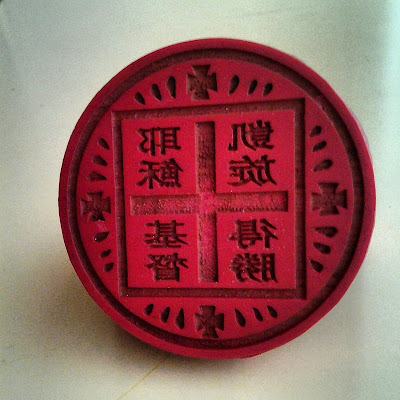
Who says Orthodoxy isn't catholic (i.e. universal)


A traditional Greek prosphora seal with the Ι(ΗΣΟΥ)Σ Χ(ΡΙΣΤΟ)Σ ΝΙΚΑ.


A Chinese prosphora seal.

Different cultures, different languages, but still the same universal truth.

Saturday, September 15, 2012

The Exaltation of the Cross

In the Orthodox Church, there are three major commemorations of the Cross itself, on August 1, on September 14 and on the third Sunday of the Great Lenten fast.  When you add in other minor festivals and events where the cross figures prominently (including the stavrotheotokia at Vespers on Tuesday and Thursday nights) and also the troparia of the hours on Wednesday and Friday, the Cross is commemorated in Orthodox hymnography and prayers for the entire year.   As St. Paul said, "God forbid that I should glory except in the Cross of our Lord, Jesus Christ."  Our boasting is in an instrument where God humbled His very Self.  No longer is it instrument of torture and death; it is now the means to life itself.  And no longer is it merely a symbol, but it is a weapon.

The Lord Himself used His own Cross as a weapon when He broke down the doors to Hades and lifted up Adam and Eve and the Patriarchs and their descendants from the bondage which kept them.  You can see that in the icon reproduced for this post.  Christ holds His Cross with one hand and with the other reaches out to Adam. 

For us, too, the Cross of our Lord should be a weapon.  It is the weapon which the demons fear and for which they have no countermeasure.  The psalmist says,"The light of thy countenance O Lord, is signed upon us."  And it has been signed on us with the cross which was made upon our heads, hearts, hands, feet when we were baptized and chrismated.  It is a weapon which we all have when we sign ourselves and which we can call upon at any time to fend off the attacks of the evil ones.  We should never fear to use it.

For this reason, and many more, do we then exalt in our Lord's Cross.  Historically, this feast commemorates the retrieval of the Cross from the Sassanids by the Roman Emperor Heraclius I in the 7th century which was then returned to Jerusalem.    Even Heraclius, I would presume, recognized the power of the cross to vanquish enemies of the faith and maybe that is why he set out to retrieve it.  But whatever the historical basis for this feast, we should always rejoice in the cross and make it part of our spiritual arsenal.  Sign yourself with the cross daily and with faith.

Monday, September 3, 2012

The Parable of the Vineyard and the Tenants

On the thirteenth Sunday after Pentecost, the Church's lectionary appoints the reading of parable of the vineyard and the tenants from the Gospel according to St. Matthew 22:33-42.  It is especially fitting that this Gospel be read at this time of year.  We have just begun a new year and our Lord's Crucifixion and Triumph over death is manifest everywhere in our hymnography as the Exaltation of the Cross is not even two weeks away. 

There are many interesting things to speak about this parable and my priest did that on Sunday, but one thing that I thought he could have really hit home on relates to Orthodox soteriology and how it fundamentally contrasts with the soteriology defended by the Roman Catholics and Protestants.  I need not give a full synopsis of the parable, but one notices that the Master of the vineyard repeatedly sends his servants to the tenants to collect what he is owed. Each time the tenants prevent the servants from fulfilling their duty either by beating them, stoning them, or killing them. 

It's interesting to note that the Master, after the first incident, did not just immediately go there himself and deal with the tenants, but kept giving them chance after chance to repent and do what was required.  As the Master did, so our Lord God has continually given us chance upon chance to repent and come to realization of our errors.   In Catholic and Protestant soteriology, God's honor was so hurt and violated with the onset of Adam's sin that He, essentially, turned away from man.  He could not look at man in the face again because divine justice dictates that His honor be satisfied first.  And His honor was satisfied by having man wail on His only-begotten Son, Jesus Christ.  And since that event, God can now look us in the eye once more.

This is known as Penal Satisfaction and has been promulgated by such scholastic thinkers as Anselm and refined by people like Bernard of Clairvaux and Martin Luther.  It is such a disgusting system of thinking about God.  And it is so fraught with legal and juridical terminology that one can wonder if God has any compassion at all!

But contrast this with the Orthodox view.  In our view, God has never "turned his back on us," sinners though we be.  We have turned our back on Him.  And every time we do turn our back on Him, He comes to meet us face to face.  He has done this since the first sin in the garden.  That is a major difference between the Orthodox understanding of God and the Protestant/Catholic view.  As a result of this, the Orthodox do not hold to the notion that God's sense of divine justice warranted that His own Son be horribly beaten and mercilessly put to death in order to satisfy that wrong done to the Godhead.

Such is the same with the Master of the Vineyard. He did not just turn his back on the tenants waiting for his honour to be satisfied somehow.  He kept sending servants as the Lord sent Prophets.  Then, he even sent his own son as the Lord sent His Christ.  The sending of the Prophets and the Theanthropos, Christ, was done with our Lord trying to look us in the eye, not from us trying to look to Him which couldn't be done because His back was turned.

In this new year, we are given even more chances to do the right thing, to give what is the Lord's.  We are still in need of our Lord's Cross and Resurrection, for without it, there is no hope in our salvation.  But if there was no room for us to do anything, then why would God send Prophets or His son?  Evil people we may be, but we are not automatons.  Evil people still have a free will, wounded as it is.  Automatons do not.

On a side note, ccording to sacred tradition, this particular parable was delivered on Holy Tuesday.  It is noteworthy that at the end of the parable, St. Matthew says that the Pharisees and the High Priests were afraid to arrest Him, because, in the eye's of the crowd, Jesus was a prophet and they did not want to rouse the crowds against them.  What a difference 24 hours make!

Saturday, September 1, 2012

The New Year


"The Spirit of the Lord God is upon Me because the Lord has anointed me to preach good tidings unto the meek; He has sent Me to bind up the brokenhearted, to proclaim liberty to the captives and the opening of the prison to them that are bound; to proclaim the acceptable year of the Lord and the day of vengeance to our God" (Isaiah 61:1-2).  

On September 1, our Lord Jesus Christ arose in the synagogue to take his turn to read from the Prophets.  He read that passage from Isaiah and then claimed that Isaiah's prophecy had now come to fulfillment and his message of repentance for the Kingdom of God was at hand officially began.  Thus, we commemorate today as the beginning of the Church year.  Happy New Year!  May God grant all of us a year of blessings and peace and repentance.

Friday, August 31, 2012

Need Proof that Lutherans are Iconoclasts?

Give this a listen. 

Now, I don't know how mainstream or accepted Pr. Curtis' viewpoint is on the subject of the depiction of images and their use in the liturgical life of the church, but considering that this program aired on a station that is aligned with the LCMS, I'm sure it has some official imprimatur.  Essentially, Pr. Curtis disagrees with the way that iconoclasm arose and was implemented throughout mainly the confines of the Eastern Roman Empire (i.e. Byzantine Empire), but agrees with their overall intent.  Images can be worshipped and since they can be abused and misused, they must, therefore, be removed or only used as pictures of art for strictly education purposes, but never used as devotional objects for a deeper spiritual relationship with the Lord.  This is really quite fascinating since the Lutheran Confessions subscribe to the canons of the Seven Ecumenical Councils, because (quia) they agree with the Scriptures not insofar (quatenus) as they agree with the Scriptures.

This is nothing more than gnostic dualism, a total disregard for the material world as something evil and that the body, the flesh have no role in repentance or in our salvation.  Of the five senses, Lutherans only will allow one in worship:  that of hearing which comes from an overreaching interpretation of the passages in the Gospels that faith comes from hearing.  Given the propensity of Lutherans to define everything in strict categories, I'm sure that some Lutheran theologians have wanted to insert the German word allein after those passages as Luther did with Romans 3:28.

This just proves that as much as the LCMS is trying to reassert some degree of its confessionalism, it is picking and choosing from its tradition.  Quite unfortunate.

Sunday, August 26, 2012

Joyous News

Courtesy of a proud papa, my son, Simon Eleftherios, was received into the Holy Orthodox Church through the mystery of Baptism.  He was also chrismated, tonsured and received his First Communion. He made very little fuss and was very good about being dunked three times by some stranger (i.e. my priest) and being held for the majority of the time by his godfather (who is, incidentally, my godson), someone he also didn't really know.

The chanters chanted marvelously and it was a joy to have friends and family to share in this great moment.  After being so elated seeing him come into this world from my wife, I was equally elated to see him come into the Kingdom (with some Greek helping him along the way)!

Εις ετι πολλα!