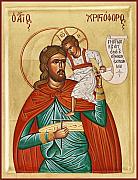
Yesterday, May 9, was my name day. St. Christopher, my namesake, is commemorated on that day. You may not have heard much about it since yesterday was the final Sunday of Pascha, it was Mother's Day and Christopher shares his commemoration day with the Prophet Isaiah. It also doesn't help that the Roman Martyricon has removed him altogether following the reforms of the calendar made in the wake of Vatican II (his commemoration on their calendar though was on July 25). It is of further little help that even the Prologue of Ohrid has only this to say about him:
Christopher was a great miracle-worker. He is especially venerated in Spain. The people pray to him primarily for protection from contagious diseases and great pestilence. He suffered for Christ and was glorified by Christ in the year 249 A.D.
Much of what we think we know about St. Christopher is rooted in legend. That is why he was dropped from the Roman Calendar. Despite this, the Church has never said that the acceptance of the literal truth of the lives of the saints or even the Theotokos was absolutely necessary. But what is the truth behind such legends?
As I so often tell my students, truth is not fact. Fact answers "what" questions. Truth answers "why" questions. So why celebrate St. Christopher's Day even if he was not actually a martyr and did not actually carry the Christ child across a river before martyrdom under the Emperor Decius? I believe Elysia Younes writing on the Antiochian Archdiocese website gives a good answer: "Although so little is known about the life of St. Christopher, there is so much to be gathered even from his experience carrying Christ across the river. We all bear and are called to bear and to “put on” Christ by taking up the crosses in our lives that He has given to each of us. St. Christopher bore his cross and eventually suffered martyrdom for the faith, fulfilling the commandment of Christ, “He who does not take his cross and follow Me is not worthy of me.” (Matt 10:38)
May Christopher continue to intercede for us before the Dread Judgment Seat of Christ for relief from afflictions of this life and that we may be made worthy of the promises of Christ.
*Also, a sidenote. Iconographers who depict St. Christopher with the head of a dog are in error. Christopher is called "dog-faced" because his countenance was so terrible to behold.


